 Joel Artista
Overcoming the Demons in Kolkata, India
Posted on March 25, 2016
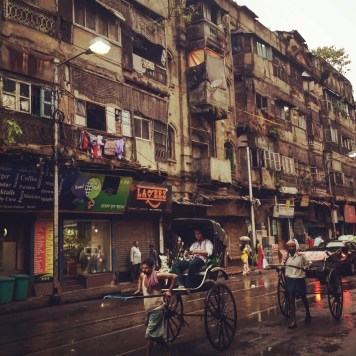
Kolkata, formerly called Calcutta, is often synonymous around the world with the misery of poverty, conjuring up images of Mother Theresa giving refuge to the destitute and dying. While even today this characteristic of the city does exist, it is unfortunate that the world is often unfamiliar with another Kolkata, one that is more well-known to Indians: the nation’s capital of arts and culture, with colorful street life, breathtaking scenes of life along the Ganges River and a population passionate about its politics and spirituality. My wife, CJ and I fell in love with the city on our first day as we wandered through the colonial-era bazaars, bombarded with the intensity of the sites and smells of the bustling crowds, street vendors, Hindu shrines, rickshaws and rain-battered British-era buildings. I didn’t want to look down for an instant for fear of missing another magical scene, which would seemingly appear around every corner.
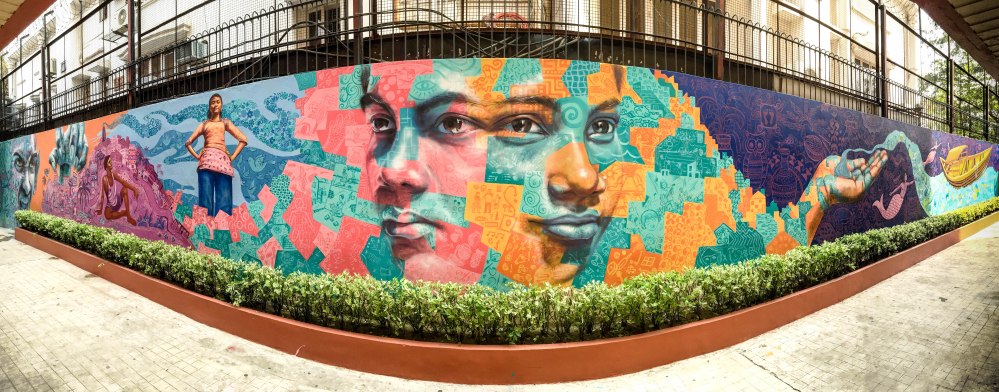
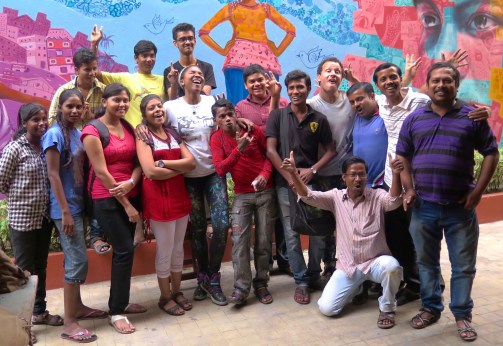 Near a leafy lake in the south of the city lies the Birla Academy of Art and Culture, a hub of ancient and contemporary Bengali visual art. I was excited and honored to have the opportunity to paint a mural on a large outdoor wall on the side courtyard of the center. The project, organized by the Meridian International Center, the US Consulate in Kolkata and the local NGO, Banglanatak dot com, was to be a collaboration between myself, a team of Bengali artists and a group of teenagers who were receiving support from five local NGOs. These young people had been through a variety of tragic life situations at early ages, facing issues including homelessness, human trafficking, poverty and addiction, but were working to overcome their pasts and were specially selected for this project because of their passion for visual art.
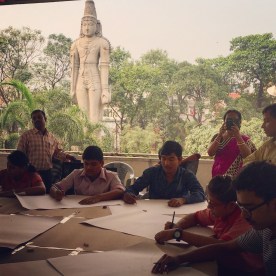
At the introductory workshop on the first day, I met with all the participants and gave a presentation on mural art. To break the ice, the group took part in some games and activities, before settling down to design our mural. After some discussion, we decided on representing a journey from a dark past to a future full of hope. The teens each came up with drawings to illustrate the different phases of the journey. The adult artists and I were all impressed by their skill level and creativity in turning their concepts into imagery. We ended the day by contemplating all the drawings and deciding how they would be woven together to create a cohesive mural design.

The following day, we were ready to begin our week of painting! CJ and I began each day with team-building activities, and each day the kids opened up more with each other and with us. In one section, they painted the personification of the demons in their lives and communities, portrayed as a giant fiend terrorizing a city. This concept was originally conceived by one of our most enthusiastic teens, Prantik, who is deaf and announced on the first day that he communicates with the world through his art. He did not allow his disability to get in his way by any means, and was among the warmest, most playful and personable young people in our group. He volunteered to model for the face of the demon and succeeded in doing a great monster pose!
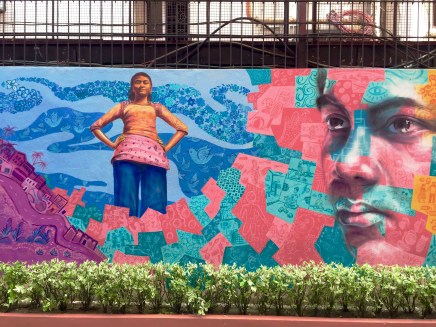 In the next section, each student painted representations of that which gives them peace, strength and support to fight these demons: positive relationships with family and friends, activities such as art and music, religious faith and education. A giant girl towers over the city, a reference to the tendency in Indian art to paint important, powerful people as being larger than others. In a twist, this girl is portrayed as large and powerful despite being a normal teenage girl who has been through struggles, much like the participants themselves.

A boy and girl, modeled after Ravi and Jyotsna, members of our young artist team, have their faces joined together in the center of the mural, referencing the half male, half female Hindu deity Ardhanarishvara, and balance in the universe. The girl reaches out from the city and unleashes a river from her hand, which is filled with the future versions of our students: we asked each one to envision how they see themselves in the future. They painted their future selves as athletes, fashion designers, graduates, artists, politicians, scientists, and as having families. This exercise is intended to encourage young people, especially those who have been through trauma, to envision the positive future that they wish to manifest in their lives. The background is filled with Bengali folkloric art, which the local artists gave the teens a lesson on, and a typical Ganges River boat rests on the water.

One of our stand-out participants was Binod, whose warm, outgoing spirit seemed to be in direct contrast to his life circumstances, which he was open about sharing with the group. He did not know where he was from, nor to what family he belonged. He had a chaotic upbringing, with bouts of homelessness and instability in which he frequently moved around. Now, at 18, he lives in a rehabilitation house for substance abuse. Despite his past, or perhaps because of it, he reached out with generous affection to his peers and to adults, even taking to calling me “dad” and CJ “mom” during the project. He invited us to visit the center where he lives, as well as another for younger children who also had suffered from addiction. It was shocking to see kids as young as 8 living there, but soon we were laughing and playing and dancing with the kids, who were hungry for our attention and affection. While I was glad to see that some support existed for these children, I knew that it could never replace the families that weren’t able to care for them nor the stability that is so important for a young person’s development.
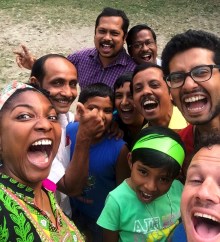
Several of the local artists who partnered with us on this project live in a community in north Kolkata by the Ganges, and we were honored to be invited there to meet their families. Our friend and artist, Sayak, took us to his home and studio, and his mother cooked an absolutely delicious Bengali lunch. We visited the homes of Broto and Babu as well, and took a ferry down the iconic Ganges, or Ganga, River. That evening we all visited the famous temple to the goddess Kali, which was full of worshippers giving offerings to her and placing flowers in the river.
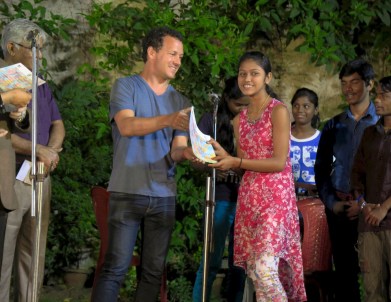
At the closing ceremony for the mural project, dozens gathered around to celebrate the artwork and its message. The teens were clearly proud of what they had accomplished, posing for photo after photo with the mural and with each other. Speeches were given, folkloric Bengali music was played and there were congratulations all around. It was sad to say goodbye after our time creating together and forming bonds, as we didn’t know when we’d all cross paths again. But we had all learned from one another and discovered something about ourselves through the process. Thanks to everyone who contributed to this project: the Meridian International Center, the Birla Academy of Art and Culture, the US Consulate in Kolkata, Banglanatak dot com, CJ and all our incredible adult and youth artists!


Combatting Human Trafficking Through The Arts
Posted on March 18, 2016

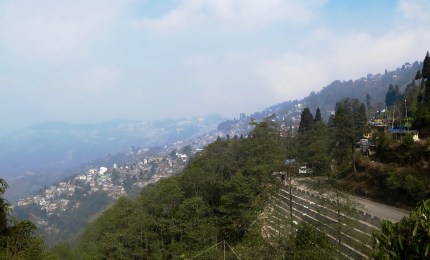 Looking at a map of India’s eastern state West Bengal, one will notice that it has an unusual shape. At the top, a tiny sliver of land shoots hundreds of kilometers north, like a little tree growing out of rest of the state, which includes the capital city of Kolkata and the iconic Ganges River. This sliver pushes up into the Himalayas, and borders on Nepal, Bhutan and Bangladesh, not far from Chinese-controlled Tibet. It is a fascinating place, with incredible mountainous views, the world-famous Darjeeling tea fields and Buddhist and Hindu temples spotting the landscape. However, it was none of these things that brought me here, to the small city of Siliguri. Upon arrival, I met with my team of local artists and Nishi Kant, director of the Indian NGO Shakti Vahini, who educated us on the situation here.
 Underneath the physical and cultural beauty lies a tragic reality; this area is the epicenter for human trafficking in South Asia, where tens of thousands of people a year are taken from their communities here or from neighboring countries, where they are trafficked through Siliguri on their way to their various destinations throughout India and beyond. Also known as modern-day slavery, this issue takes many forms. Women and underage girls are sold into sex slavery in brothels across the region, while some are forced to marry older men. Others are sold into forced labor, with females usually ending up as domestic maids and males as agricultural laborers. Violent and powerful, international organized crime rings control this lucrative business, with tactics that include offering impoverished, vulnerable people with “golden opportunities” to work in supposedly legitimate jobs, their victims only realizing their fate once it’s too late. Others are simply snatched from the street by men driving by in cars, never to be seen again.
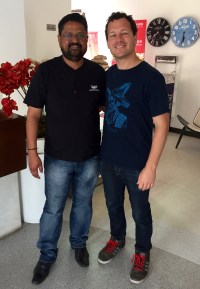
Shakti Vahini’s Nishi Kant
Combatting this crisis requires the tireless dedication and coordination of many societal actors, including NGOs, law enforcement, the Indian government and the international community, many of whom came together in Siliguri in February of 2016 for the International Anti-Human Trafficking Conclave. Organizers included the US Consulate in Kolkata and Shakti Vahini, dedicated to ending trafficking and supporting the survivors in their struggle to re-integrate with society and combat the stigma that they often face once they return to their communities. As part of the conclave, my team of artists and I were to paint a large-scale public mural in a highly visible location in order to raise awareness for this issue.
As Nishi explained to me, one of the most important aspects of fighting trafficking is educating the public and enlisting them in the struggle. Ordinary citizens must understand what it is and recognize it when it takes place in their community. They need to have the information about who to inform when a girl disappears, understand that not every job offer is legitimate, and have compassion for returning survivors of trafficking, rather than rejecting them. For this reason, artists have an important role to play.
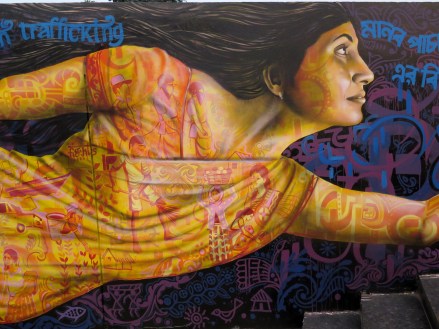 The main figure in our mural is a woman who had been trafficked, named Sangeeta. She is a dancer and works with the organization Kolata Sanved, which uses dance as a form of therapy for trafficking survivors. As part of this work, photographer Brooke Shaden partnered with the women and girls to create a series of photographic self-portraits in which they each chose a pose that they felt represented their stories. Sangeeta portrayed herself having her ankle gripped by a menacing hand, while she reached toward another hand for support. When Kolata Sanved collaborator Laura Price showed me this photograph, I was moved by the image and the story behind it, and received permission to use it as the central figure in the mural.
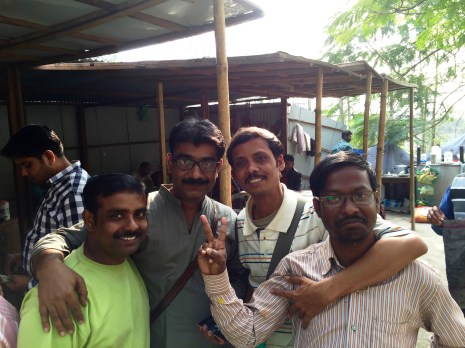 Inside Sangeet’s sari, the artist team, who included the four Kolkata-based painters Anindya, Saptarshi, Santanu and Binod, depicted the variety of issues that surround human trafficking. Interwoven throughout the piece are images from Bengali folkloric art. Working with this talented team was a great experience for me. We painted together, learned about each others’ lives and cultures, and ate lunch together at a nearby local Bengali outdoor eatery, where the artists taught me how to eat in the traditional Indian manner: with your hand, which requires a special technique when eating foods like rice and daal, a chickpea dish. When the mural was complete, we took a day trip up through the Himalayan mountains, to the breathtaking city of Darjeeling. Later, while working together on another project in Kolkata, my wife and I had the opportunity to visit their homes and meet their families; a real honor!
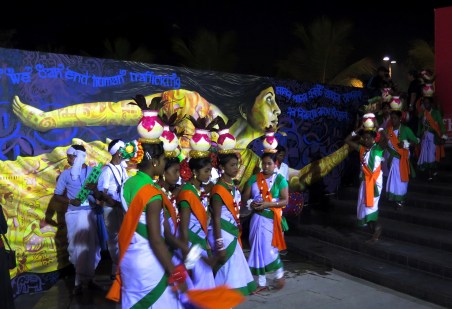 On the opening day of the International Anti-Human Trafficking Conclave, dozens of people gathered in front of the mural. Local musicians and dancers performed, including a group of women dancers who had also survived the trafficking experience. It was an inspiring moment to witness the power of people who had gone through so much, yet were determined to be part of the solution and support others who had suffered. Thanks to everyone involved in making this mural project such a successful, positive experience: The Meridian International Center, Shakti Vahini, the US Consulate in Kolkata and my four amazing artist collaborators.


Art for Gender Equality in Mumbai, India!
Posted on March 5, 2016

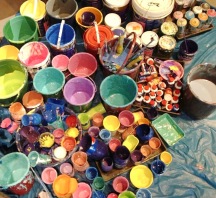 After a jam-packed month of arts-based social projects in slum communities in Delhi and Mumbai through the Shanti Arts for Action project, it was time for new adventures through a program organized by the Meridian International Center, based in Washington, DC. The program began in South Bombay’s Sitara Studio, where my wife, Karla-Jayne Thomas (aka CJ), and I joined forces with local artist Krishna Sharma to facilitate the creation of a 40-foot canvas mural designed and painted with a group of 25 local students, to be displayed at one of India’s most prominent art festivals, Kala Ghoda.
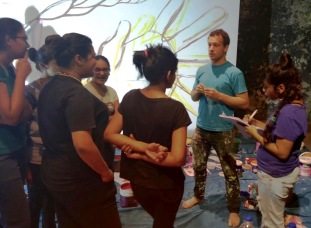
Together with our project partners from the US Consulate in Mumbai and local organizations Develop Matrix and Safe Cities, we met for the first time on a Saturday to plan the mural with the students. After some ice-breakers and introductions, we had a group discussion about gender-based issues. The participants had a lot to say and it was clear to me that these were topics that they had thought a great deal about and related to their daily experience in an intense way. They brought up issues of harassment, domestic violence, forced marriages, patriarchy in Indian society and shared personal stories of how gender inequality and sexism affected their lives. We then turned these ideas into images, with each student creating a sketch, which we then used to create a cohesive mural design. By the end of the day, we had a solid concept!
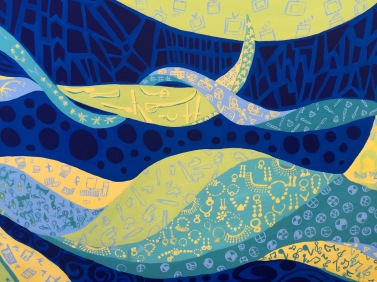 The left side of the mural is dedicated to the daily struggle for equality, and features a dark, intense color scheme. The female character’s hand is being tied down as she struggles to become free. Throughout her long hair and hand, the students wrote messages and images related to this theme. The right side focuses on a celebration of women and girls, and of the achievements that have been made toward gender equality. Participants created patterns that celebrate a diversity of females: school girls and grandmothers; professionals and house- keepers; party girls and creative types. The hand on this side has broken free and is covered with images of female accomplishment. Both sides feature male faces as well, as the students felt strongly that gender equality is an issue that affects everyone and that men had an important role to play in counteracting the forces of sexism and inequality.
 From Monday through Thursday, groups of students joined us throughout the day to paint, adding their personal voices to the mural. I can’t express enough how impressed I was with their dedication, talent and energy that they poured into the project! We often had long discussions about all kinds of things, from serious to silly, and I learned a great deal from them. It was also a pleasure to collaborate with the bright young female artist Krishna, who added so much to the project. By the end of the week, Krishna, the students, CJ and I had become a tight-knit team. We didn’t want the project to end!
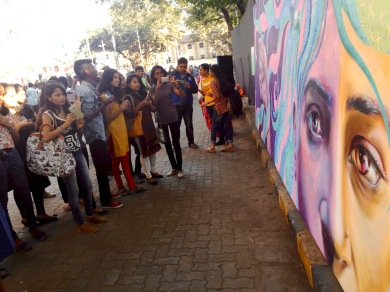 On Friday we completed some finishing touches and then the giant canvas was rolled up and moved to the festival grounds, where we unveiled it for the public on Saturday, the opening day of Kala Ghoda. It was a huge hit! Art fans crowded the mural to take in all the incredible details that the participants had painted throughout the piece. Everyone took photos and asked us questions. All the students came for the opening, and we had a good-bye circle in which we reflected on our shared experience. We were proud of our accomplishment, but sad that our time together had come to an end. Thanks to everyone involved for making this project such a huge success!


Facing the Shark in Cape Town
Posted on October 31, 2015

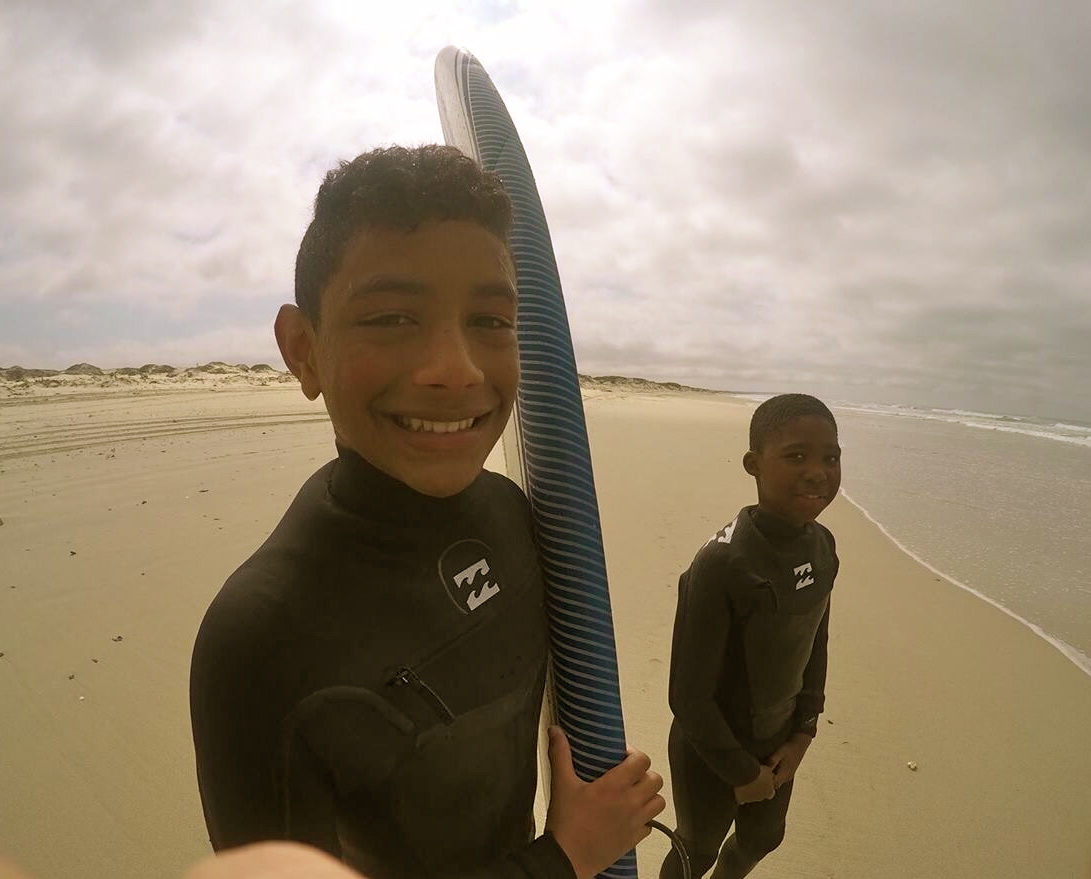 As I write this, I’m flying home to Brooklyn after an incredible two months of non-stop community mural projects for the #AddColourToLives initiative. There have been highs and lows, excitement and exhaustion, and so many interesting and inspiring people who I’ve met along the way. The final project took place in Cape Town, South Africa, in a remote community called Strandfontein, where we painted the exterior walls of the public library. The project partners included two Park Inn hotels in Cape Town, the You2Africa organization and the youth program 9 Miles Project. Founded by Nigel Savel, 9 Miles engages children from a nearby informal settlement through surfing and skating. I was greatly moved by what an important father figure Nigel had clearly become in the kids’ lives and the family-like bond that they had formed. Surfing had become a central focus in their lives and a catalyst for making positive connections with their peers and adults in their community. This connection is essential for guiding these young people into a healthy and safe future, no small feat in an area rife with violence, substance abuse and broken lives.
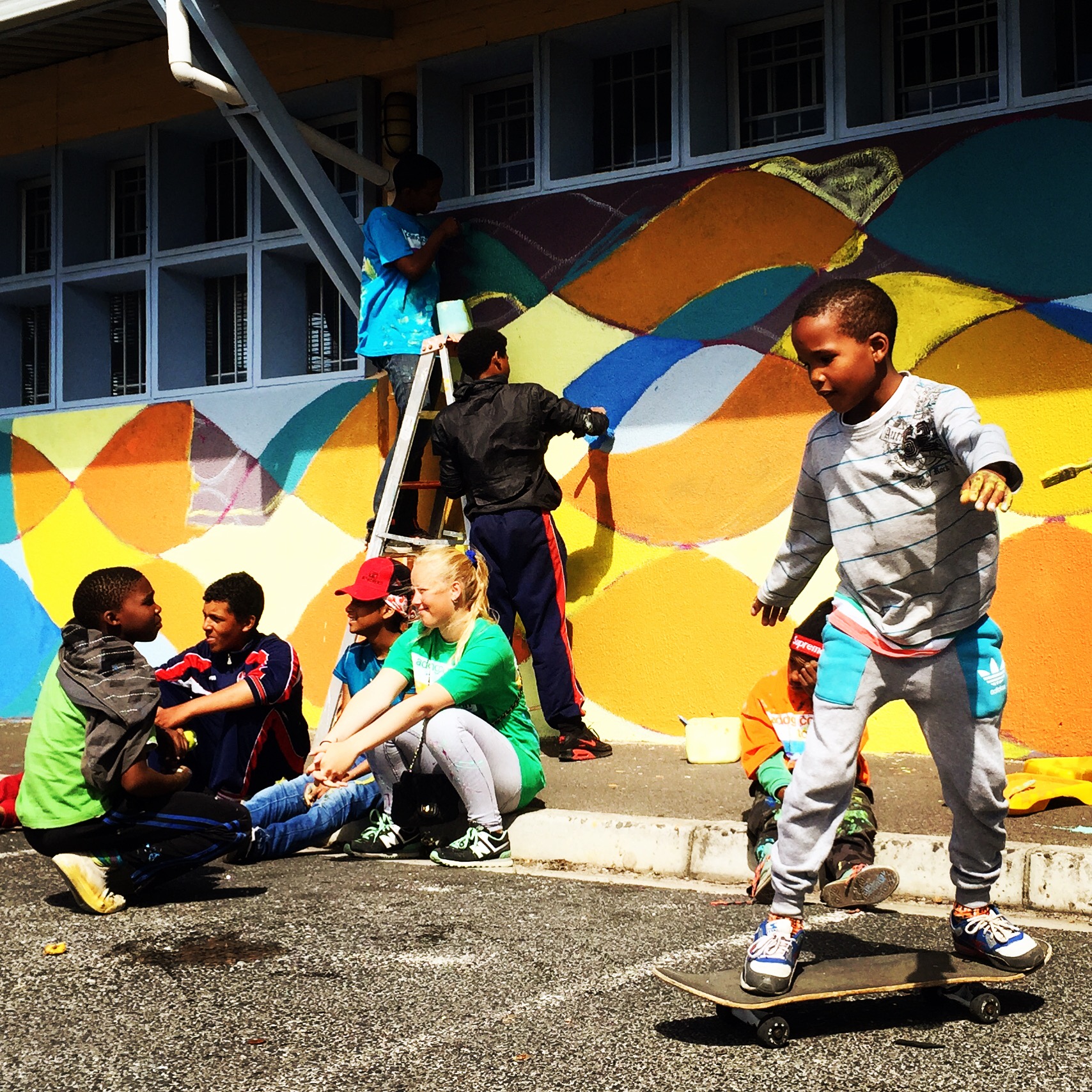 The first day, I led activities and games with the kids and gave a presentation on mural art. Together, we discussed the theme and imagery that the youth would like to paint in their mural, and I guided them through the design process. For the next week, we met every day to paint, and on a couple mornings the kids took me surfing and taught me some of their techniques! The Park Inn and 9 Miles staff members were all on hand, and we all bonded over painting and conversation. Renaldo, a media specialist, documented the project with photography and video, and streamed the project live on the app Periscope. The project became a hit, with up to 900 people a day tuning in from around the world!

The mural included a girl from the group surfing on a book, referencing their passion for surfing and the importance of learning. One of the participants, Lizé, wrote a poem on the book. Another section shows a giant shark, which is filled with monster-like faces that are the kids’ interpretation of the negative elements in their everyday environment: crime, violence and lack of opportunities. Around the corner is a boy, modeled by a participant named Bibo, who is swimming directly toward the shark, confronting him with a look of determination on his face. All around him are the youths’ expressions of the positive elements surrounding them as they work to overcome the negativity, such as family bonds, education, friendship, and positive adult role models. A final section depicts a tree growing from the ground and winding its way onto the walls, where the participants wrote and drew all the ways in which they had grown in their lives and what they dreamed of for their future growth.
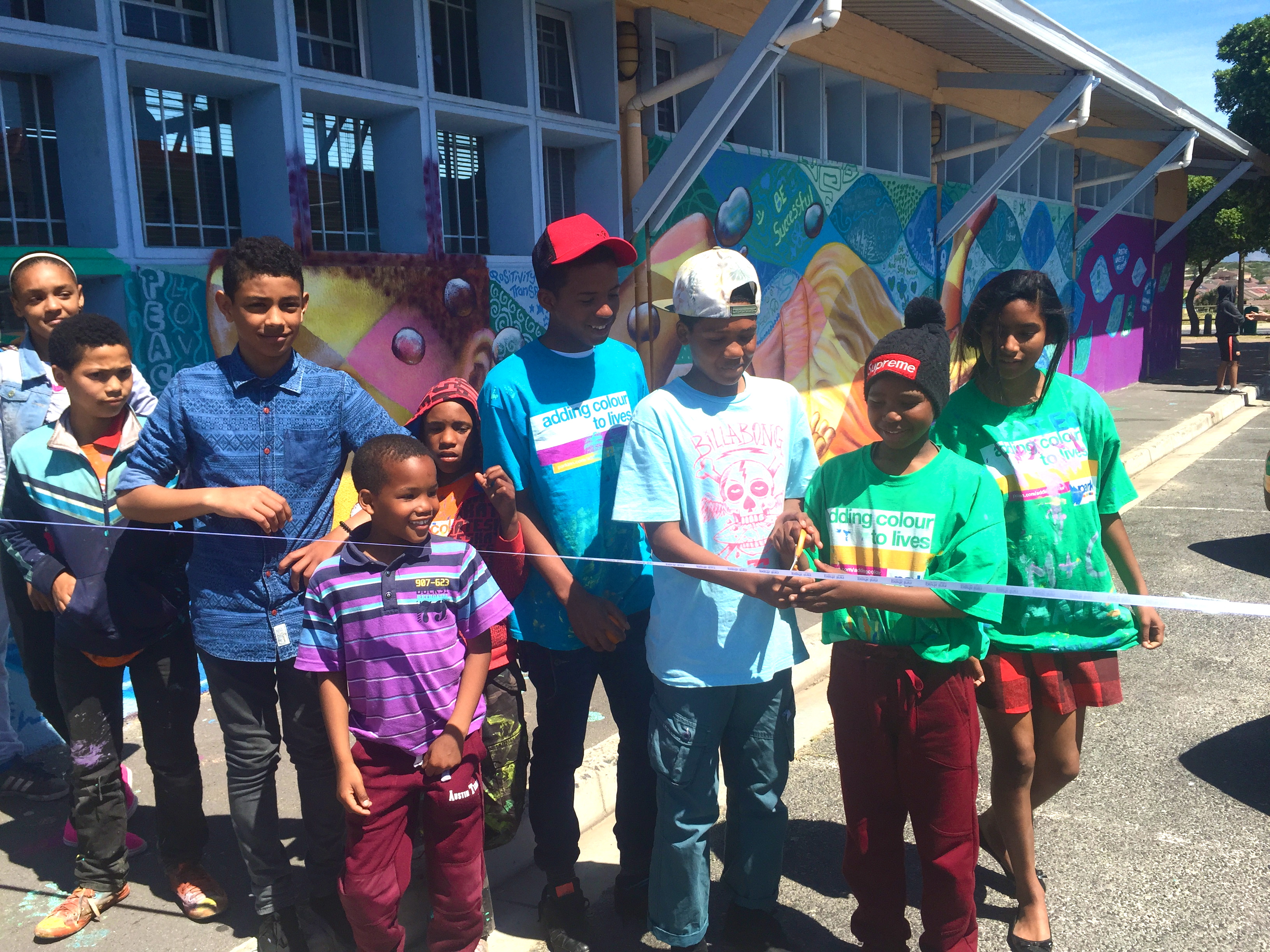
Ribbon-cutting ceremony
On the final day, we had a ribbon-cutting ceremony and invited the community to see the mural. Many of us gave speeches about what the project had meant to us, including a couple of the kids. I then had the opportunity to visit the informal settlement where the children live, and they invited me into their homes to meet their families. It was a pleasure to work with these vibrant, highly animated young people, full of attitude and youthful energy. They were so proud to present their accomplishment to their community. Thanks to them and to everyone at the 9 Miles project and the Cape Town Park Inn hotels!!


Brussels: Public Art for an Inclusive Society
Posted on October 26, 2015

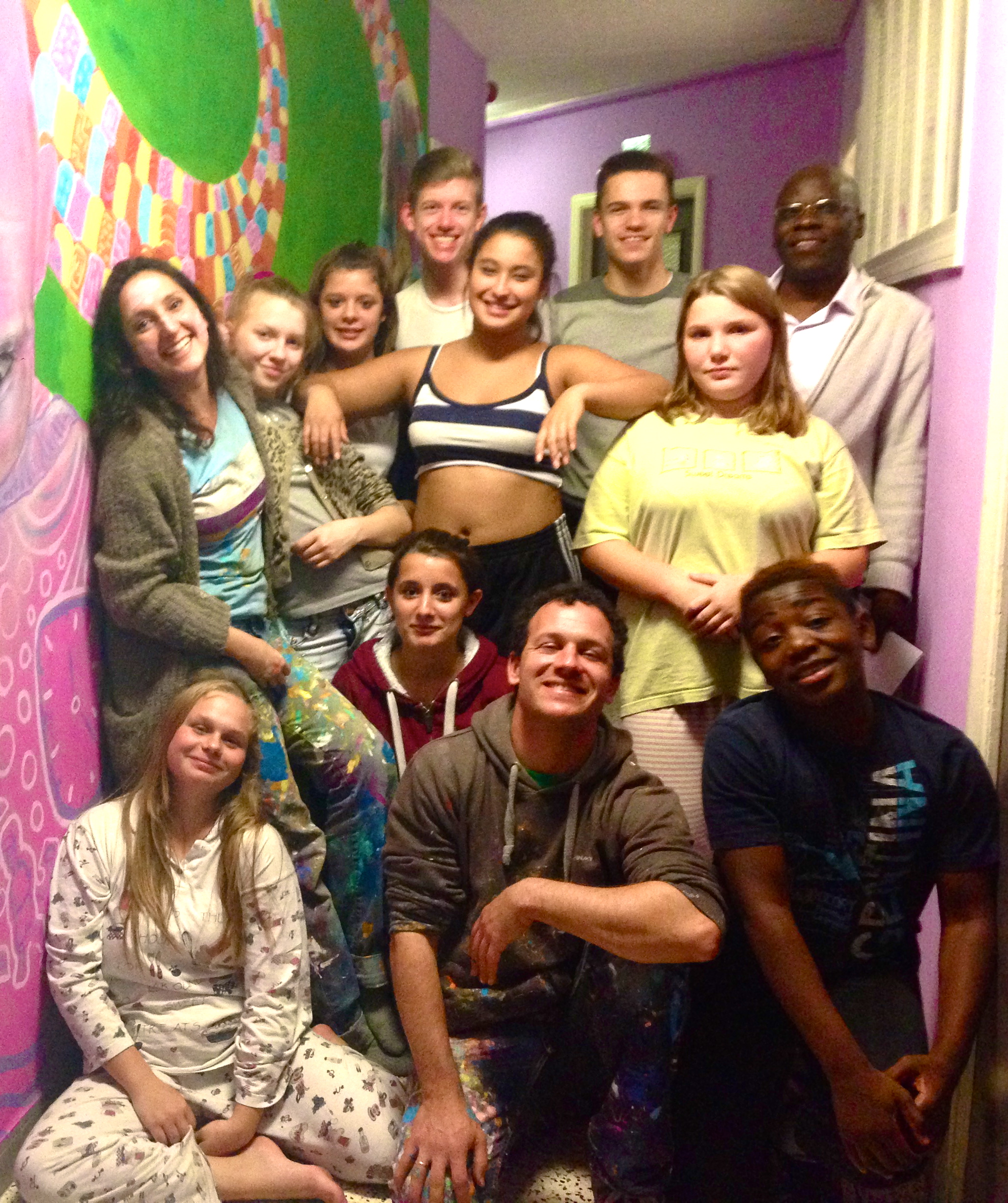 After an incredible couple of weeks in London, I was off to Brussels for the third project of the #AddColourToLives tour, which features a partnership between myself, Park Inn hotels in five cities and local youth organizations. I literally went straight from the airport to the first workshop- no rest for the weary! The first project was at the Clair Matin group home for children who have been taken from their families, where we led workshops and painted a small mural on an indoor wall. The kids were so sweet and helped me learn some French. Within a day I knew all the colors! Of course, it was also difficult to see these children suffering, having been through so much during their short lives.

Even green-haired people are included on our team!
We then began on our big public mural in Brussels, which was to be on a giant wall on the outside of the southern train station, a very prominent location. It was a massive undertaking: at 56 meters wide and 4 meters high, it was split into 9 garage doors that were no longer in use, each separated with a big concrete slab. The crew was enormous as well: we had a core group of young people and staff from three different local youth organizations, but we also invited homeless people who sleep in the train station, outreach workers from the station, Park Inn employees and community members. By the end of 8 days of painting, over 150 people had participated! As with all the #AddColourToLives projects, the imagery and the theme were created by the participants themselves during the introductory workshop that I facilitated on the first day. The area around the station has a heavily immigrant and refugee population, so we chose to focus on the importance of creating an inclusive and welcoming society. This was especially relevant because our project was taking place during the massive refugee crisis in Europe.
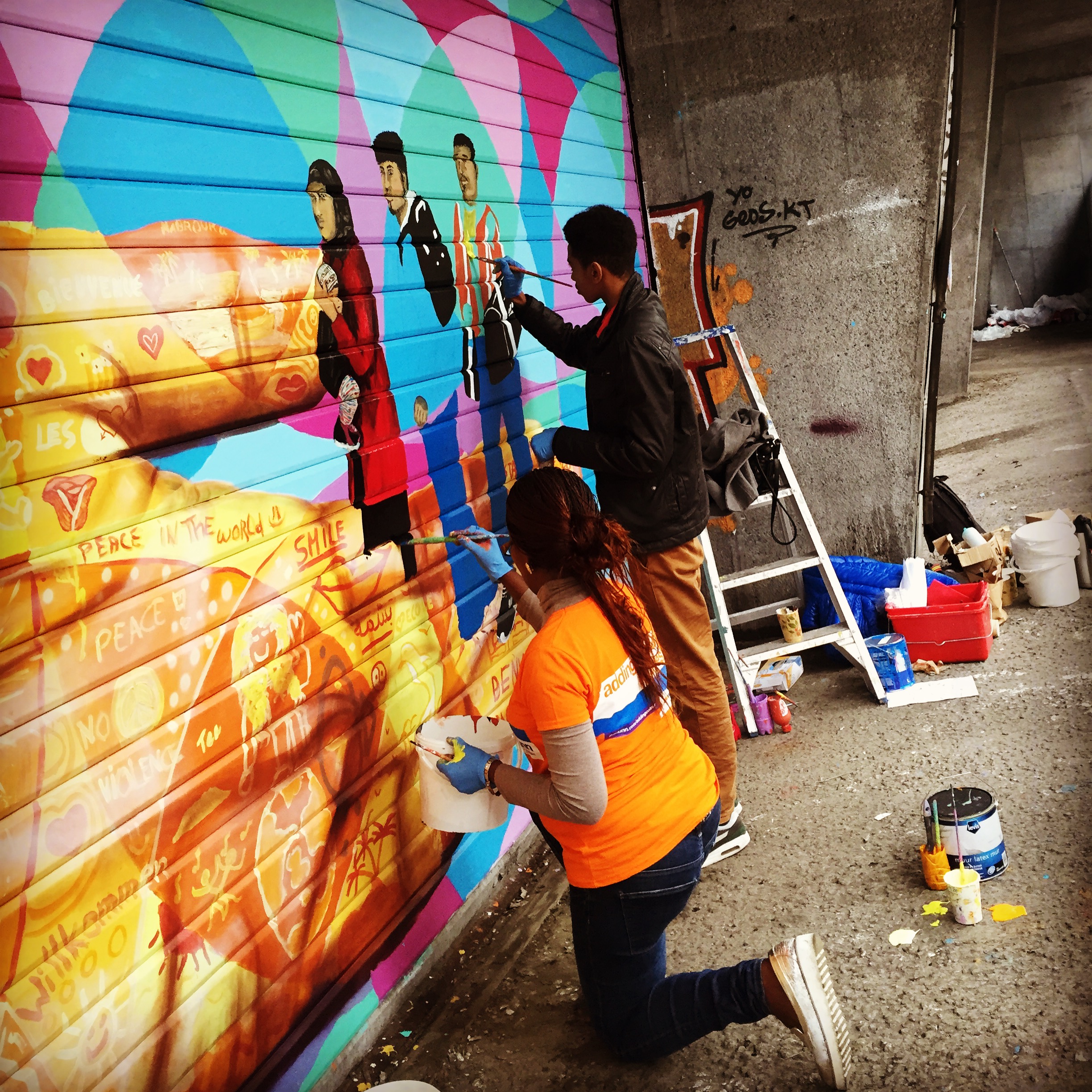
A mother and son artist team contribute to the mural!
The mural begins with a sea of migrants painted by all the participants. The colors are dark and their journey perilous. A giant hand reaches out to welcome them as three migrants walk onto it. These characters were painted by Valence, who cleans rooms at the Park Inn by day and is a talented artist by night, along with her son, Rémi. A second giant hand cradles a sleeping homeless woman, modeled by one of our participants named Muriel, who sleeps on the streets around the station and became an integral member of the team. The shapes inside the two big hands are filled with the participants’ expressions regarding the importance of an inclusive society and welcoming those who have gone through hardship. The hands belong to a character with two faces, male and female, who makes up the centerpiece of the mural. Two of our most active youth participants, Ussin and Ajer, were excited to see their faces reproduced on a massive scale for this section!
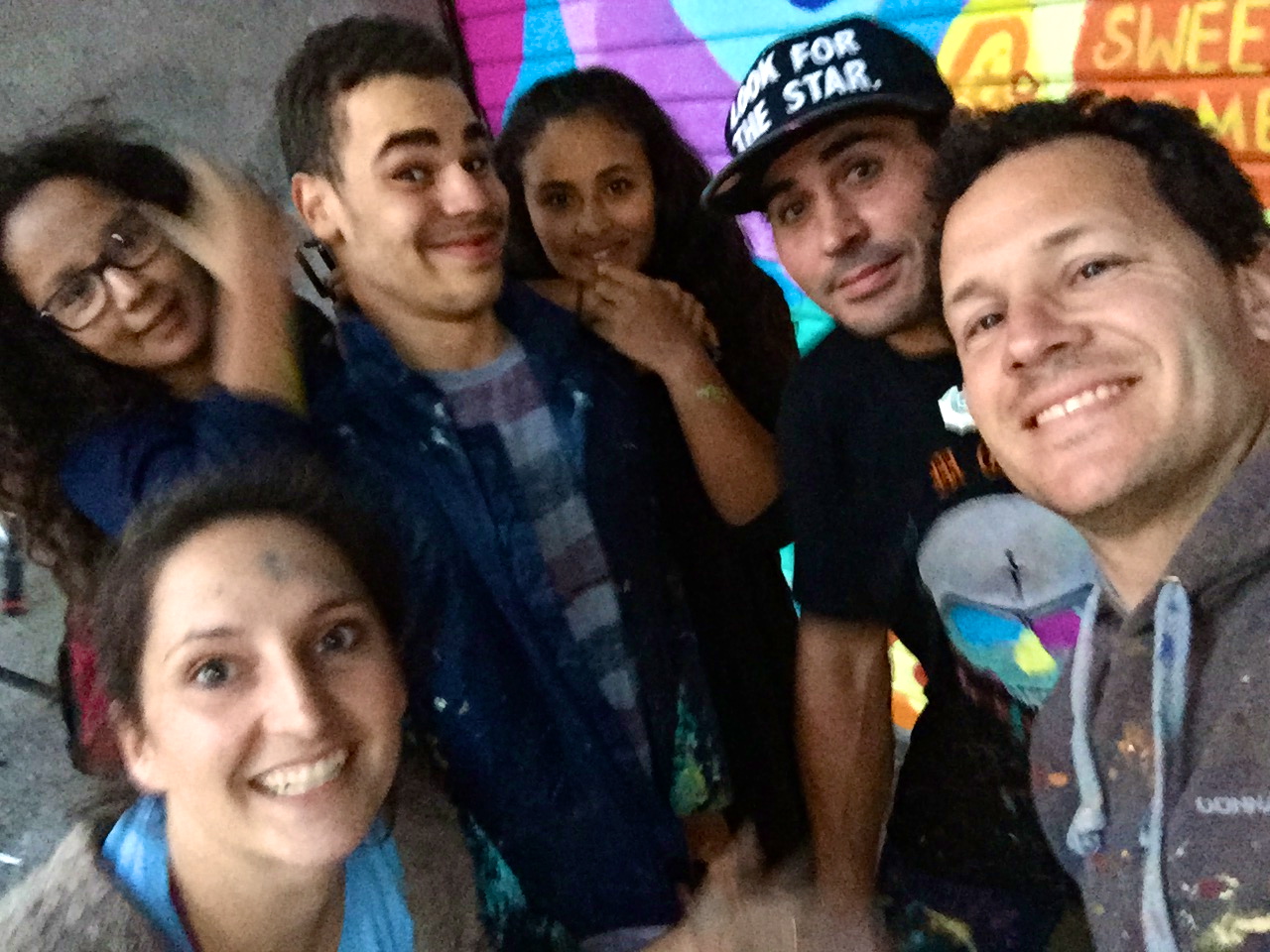 Further down, a third hand holds a bowl of fruit with a traditional Belgian carnival character. The last hand serves as a diving board for a girl (another participant, Mabrouka) who jumps off and flies over a crowd of cheering, diverse characters. These hands feature the reflections, in words and images, of the participants regarding the great contributions that immigrants and refugees make in Belgium, and to all societies. Together they make a strong statement that inclusiveness is not only for the benefit of those currently in need; that everyone will reap the rewards of a welcoming society that nurtures a diverse cultural, political and social life. By including the participation of homeless people, refugees and community members of all types, the creation of the mural itself was an example of how people can come together in common cause and respect each other’s humanity.

Said and I before embarking on a 4 hour bike ride through the Belgian country side!
Of the many people to participate I would like to highlight one man, Said, whose story illustrates the power and importance of this type of community project. While not originally part of the project, this community resident who seemed to know everyone stopped by on the first day of painting and never left: he immersed himself in the work and stayed from morning to night. I painted a giant portrait of him as the representative of the wave of migrants. At first we could only communicate with the help of others, or in the few words we knew of each others’ languages. On the third day, I was ecstatic to discover that he speaks some Spanish, which I also speak. We could communicate! Soon, he was telling me his life story.
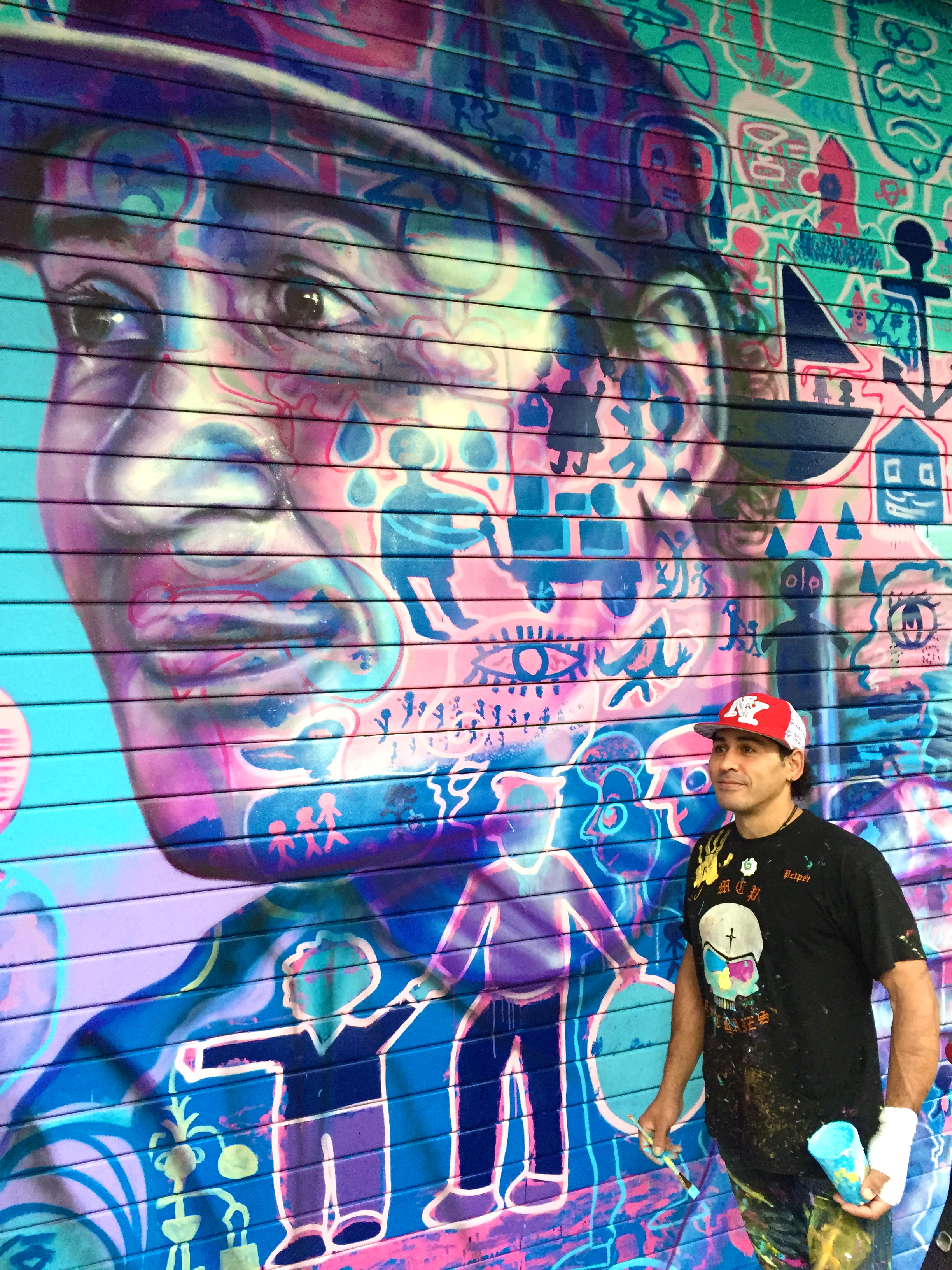
Said posing in front of his portrait
Said grew up in a port town in Morocco, where poverty led him to leave school at age 12 to embark on a highly dangerous career as a deep-sea fisherman. After witnessing the death of many of his friends over 11 years, he left and embarked on a colorful life as a circus performer, a competitive body-builder and a wood worker before taking a rickety boat to Spain in his 20’s in search of a better life, eventually ending up in Brussels. At 39, his life has gone markedly down hill. He has been out of work for three years, his stormy relationship with his wife came to a painful end and his daughter who he adores, age 6, is currently living in a group home for kids who have been taken from their families, where he is only allowed one visit every two weeks. He sometimes drinks too much and gets in fights, as do his rough friends in the neighborhood. He teared up as he told me about his family struggles, and how he is ashamed to visit his 80-year-old mother, who lives nearby, because she is so upset by the way his life is going. But the project, he told me, had given him a new outlook on life (in fact, it was Said who gave the mural its title, “A New Life”). He made positive connections with many people, all of whom were greatly impressed by his work ethic and noticed how tender and helpful he was with the kids and the homeless. He poured himself into the work every day. I could tell that he had turned a corner, and many of us began asking around the various project partners in search of a job for Said, knowing that is what he really needs to continue this upswing and finally move his life in a positive direction. This is why community projects can create positive change: it’s not principally about the artwork, but instead the positive human connections that are cultivated, often lasting far longer than the project itself.
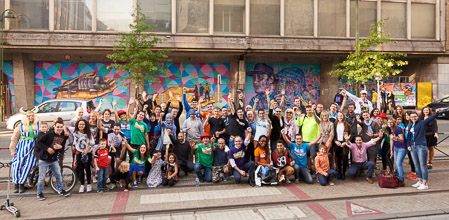 After 8 marathon days of painting, the project culminated in a big public event hosted at the Park Inn. Many of us spoke about our experiences of the project and were excited and moved by all we had accomplished and the new friends we had made. We went across the street to view the mural and take group photos, and then had a big dinner. The festivities went late into the night, with all of us sad to say au revoir but proud of what he had accomplished. I want to thank Phillip and everyone at the Park Inn in Brussels and Leuven, all the youth and adult participants who worked so hard, everyone at the train station and—last but not least– Carolyn and Inge for making this all possible and being such a pleasure to work with!!


Mural for Street Child Summit on London’s Village Underground
Posted on October 19, 2015


Mural created with street youth from 19 countries during the Street Child World Cup last year in Brazil.
In September, I had the honor of joining forces for the second time with one of my favorite organizations, Street Child United, which organizes an international network of NGO’s that focus on working with society’s most vulnerable and marginalized populations, homeless youth. Last year at the mega-event Street Child World Cup, groups of boys and girls from 19 countries who had experienced the street life all came together in Rio de Janeiro, Brazil to play a soccer tournament, create art and advocate for the rights of their fellow street youth around the world. It was a truly unforgettable experience for all of us who participated, and many lifelong bonds were created. Concrete results were seen, as evidenced by Team Pakistan, who were greeted as heroes when they returned to their country and awarded scholarships to further their education.
This year, they organized the Street Child Summit in London, where street youth advocates from dozens of countries joined forces in common cause. Among these advocates were six “youth ambassadors” from Brazil, Pakistan and Burundi who had all experienced the street life and were now participating in a 10-week advocacy course in London focused on exploring the international plight of homeless youth and studying English.
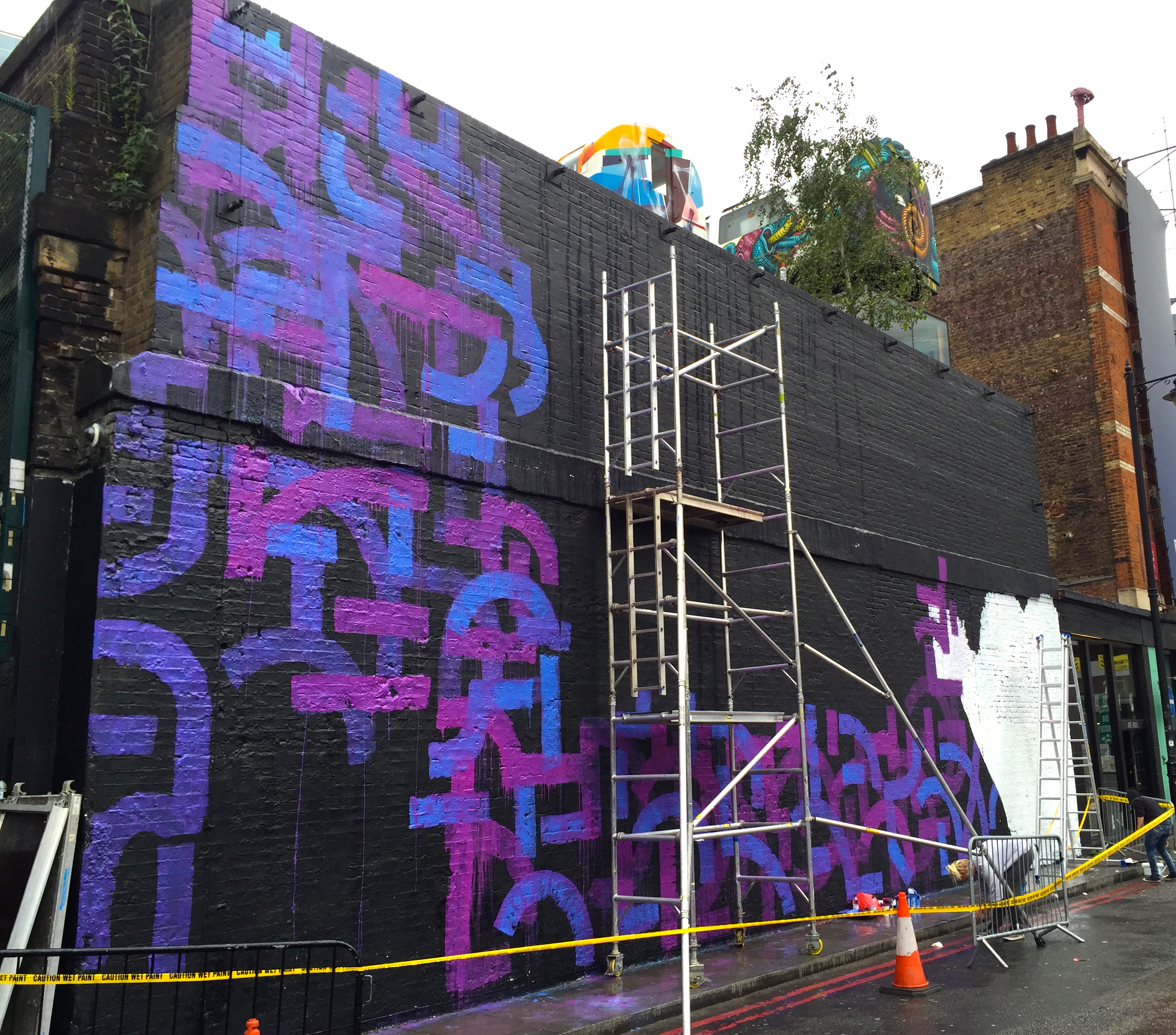
Nearby at the Village Underground, a legendary music venue with a giant outside wall that has been blessed with murals by some of the world’s most renowned artists over the years, I was given a mission: to create a huge, impactful mural that would raise awareness for the plight of street youth around the world in only four days! Luckily, I had the assistance of two talented artists (and awesome people!), Bec Dennison and Meghan O’Malley, as well the participation of the youth ambassadors. We painted a giant youth (modeled by the Brazilian youth ambassador Jessica Medeiros) filled with many smaller young people, all shouting and cheering and protesting. The figure has a megaphone, and out of the darkness she shouts into it, producing a vibrant explosion of colors, animals and a message that reads, “I may be a child/ I may live on the streets/ but I am somebody!” In line with the theme of the Street Child Summit, the mural makes a statement that while they may be excluded and oppressed by the societies of the world, street youth and those in solidarity with them can achieve a strong voice by joining together and pushing for concrete reforms.
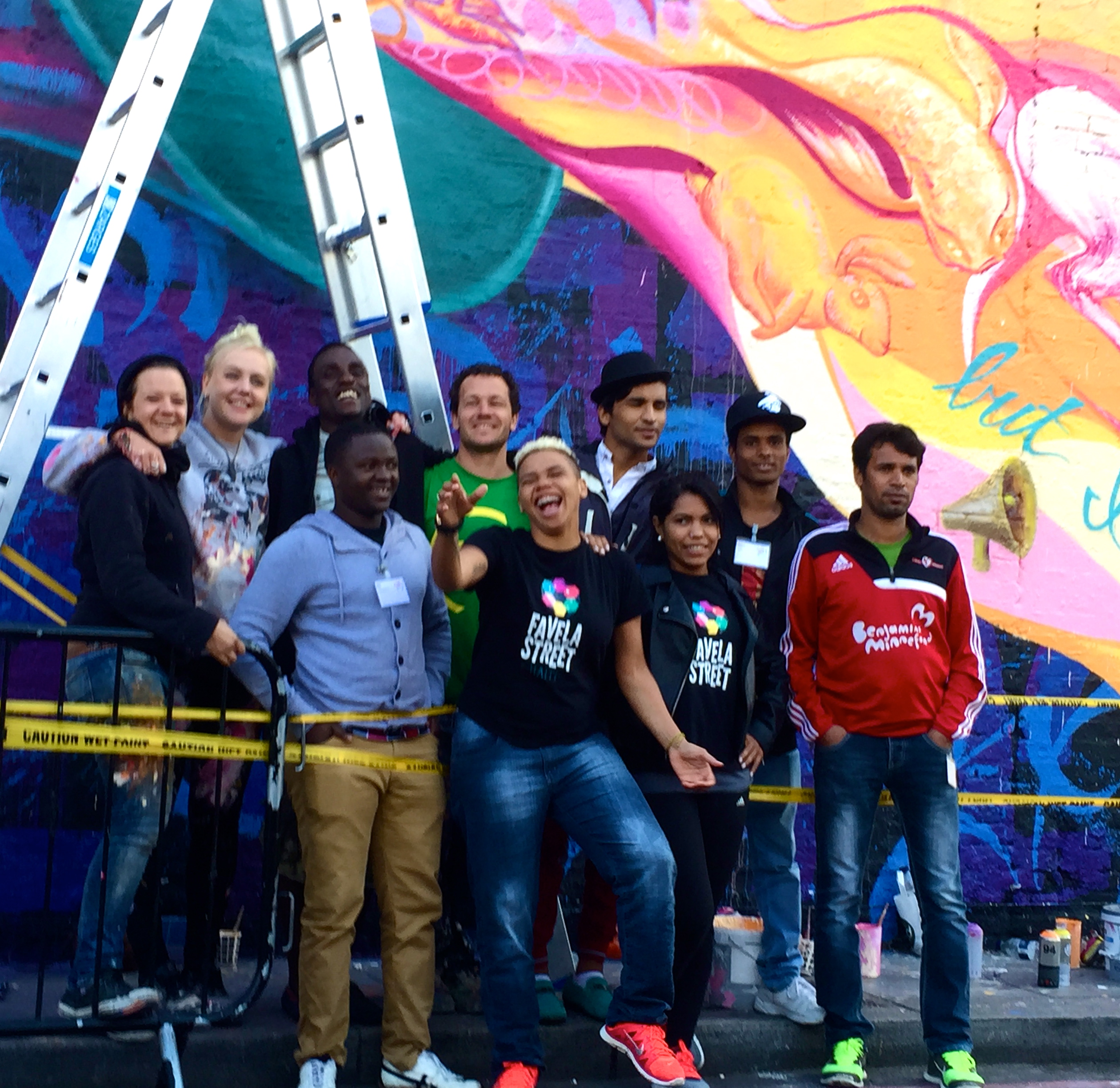 For four grueling days we worked from dawn to nightfall, through London’s notoriously dreary weather, loud trucks and traffic coming within feat of us, and lots of coffee. The street in the popular Shoreditch area was always packed with passersby, who stopped to check out the mural and learn about its message. On the final day, the entire group of summit participants arrived at the mural singing a beautiful South African song. Several of us gave short speeches, including one of the youth ambassadors, and it was moving moment in which so many incredible people came together in unity. Thanks to Jo, John, Bec, Meghan, the folks at the Village Underground (especially Javi!), the youth ambassadors and everyone involved in the Street Child Summit!!


Refugee Youth Facing an Uncertain Future in Germany
Posted on October 18, 2015

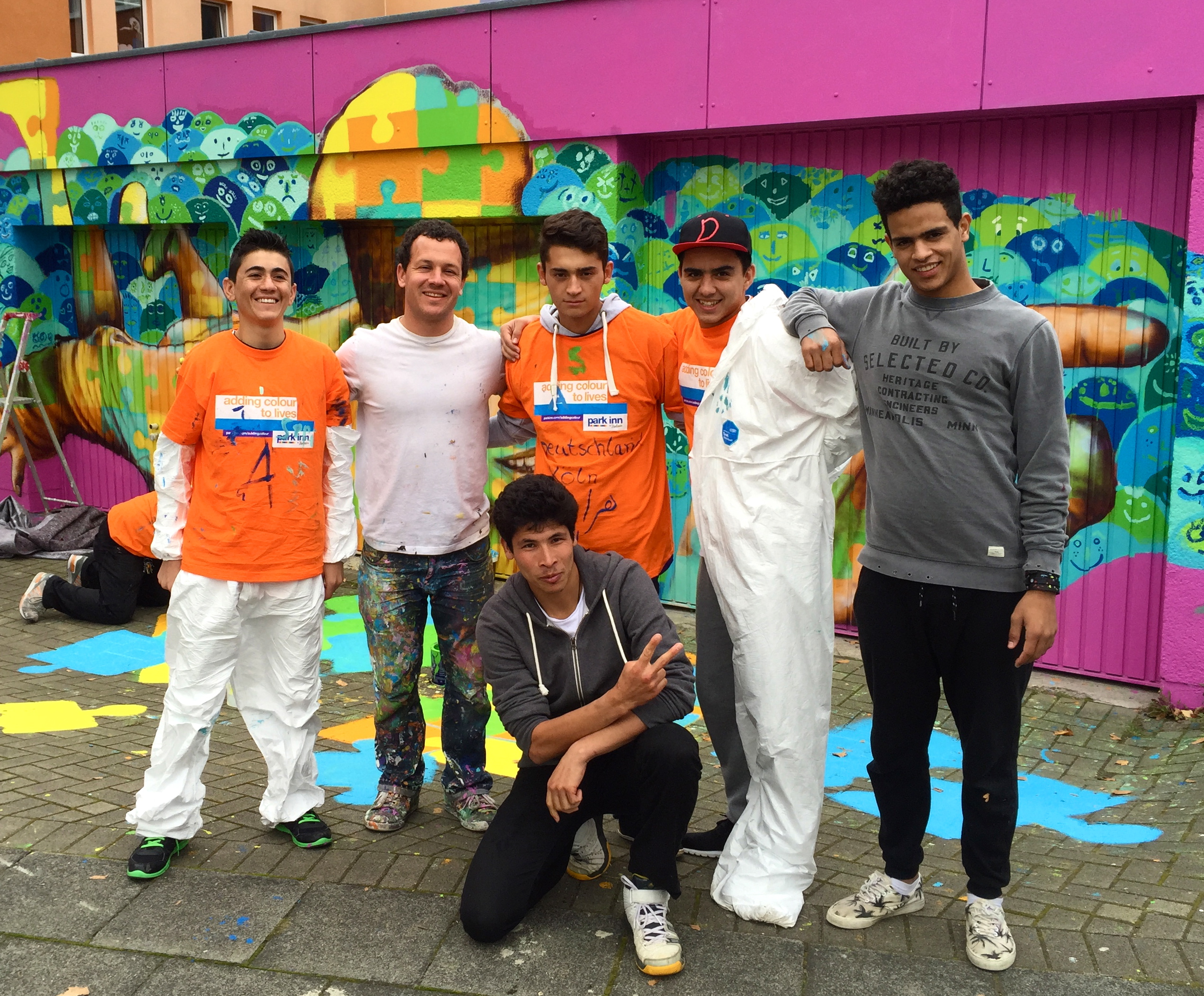 I arrived in Cologne, Germany in the midst of the refugee crisis that is engulfing Europe, with Germany at center stage of the quickly unfolding situation. The fourth installment of the #AddColourToLives tour was, therefore, very timely, as it explored the refugee experience and the importance of social inclusion in a diverse society. The project was a partnership between myself, the Cologne Park Inn hotel and the Anna-Stiftung center for children and teens who do not live with their families for a variety of reasons. Many of the teenagers who participated were refugees who had recently arrived in Germany- some only days ago- without any family. I tried to imagine arriving alone at such a young age in a strange land where no one spoke your language or understood your culture. They had experienced great hardships and trauma in the countries they came from in the Middle East, Central Asia and Africa, which they now had to attempt to recover from while dealing with the painful separation from their loved ones.
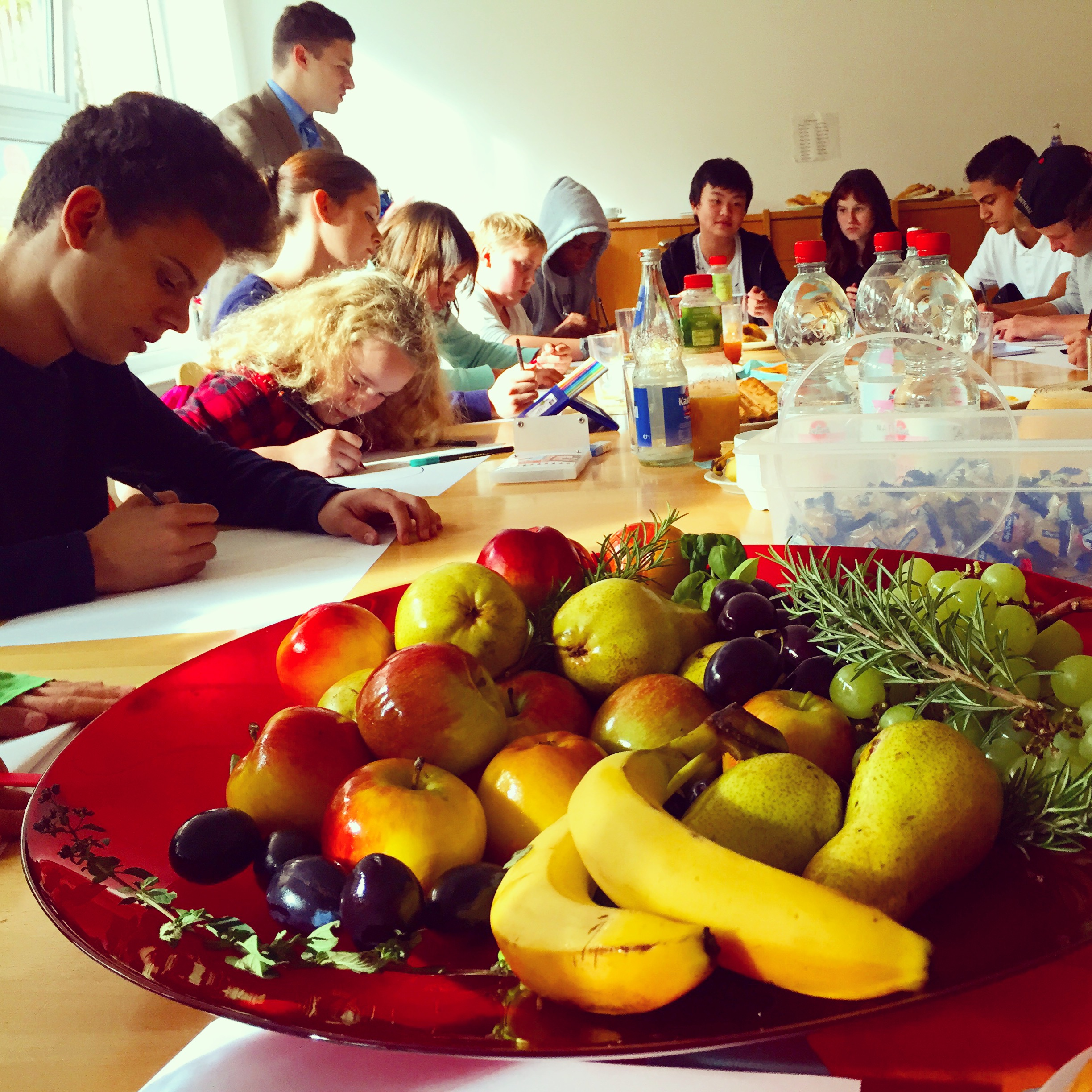
The youth participants sketching their ideas during the mural design workshop.
Needless to say, the language barrier was a challenge with this project, as many recently-arrived participants did not speak German like the other children and staff, nor English. But we made it work because of our great desire to communicate with one another,and the initial workshop was a great success. After games and activities and a presentation on community mural projects, we got down to the important business of designing a mural to be painted on the long outdoor wall of the center, which faces a busy neighborhood street. The youth decided to depict the migration experience as a river of faces flowing from dark grey hands, in reference to the difficult experiences that lead to a person leaving their homeland. As the river flows along, a teenager- modeled by a participant named Marwan from Western Sahara- drags a ball and chain behind him on his foot, but despite this baggage he is flying toward the a brighter future. He throws a paper airplane in the direction he is moving, representing the goals and dreams he is striving for. On the airplane the youth wrote questions the have for their future. Marwan is made up of puzzle pieces, which was one girl’s idea for a way to show that when one has been through trauma, it is as if one has fallen apart and needs to be put back together again.
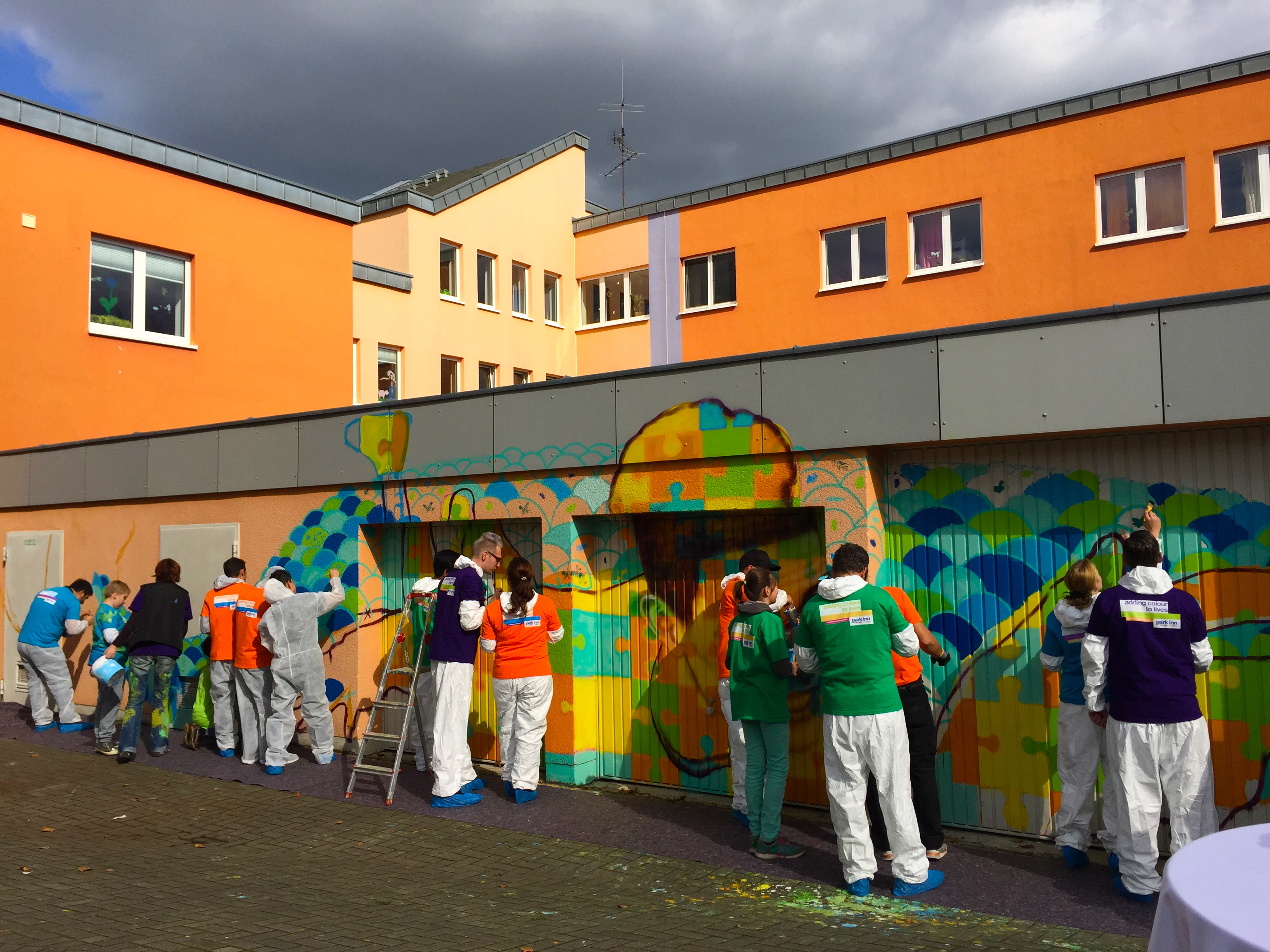 It was a massive effort to paint the big wall on outside of the youth center where they live in the remaining four days, but the kids were up to the challenge! They would paint starting after school each day, and many simply could not get enough, not wanting to leave each evening when it was time for dinner. One boy named Justin was obsessed with spray paint so we decided to make stencils so that the kids could use the spray paint to their hearts’ content on a wall around the corner from the mural. On the final day we had a big barbecue and enjoyed a beautiful sunny afternoon. Thanks to Mike and all the staff and youth participants at the center for the unforgettable experience, and also to my amazing hosts and collaborators at the Park Inn: Paul, Oliver, Ricarda and the whole crew!


Unity Through Art in Malmö, Sweden
Posted on October 12, 2015
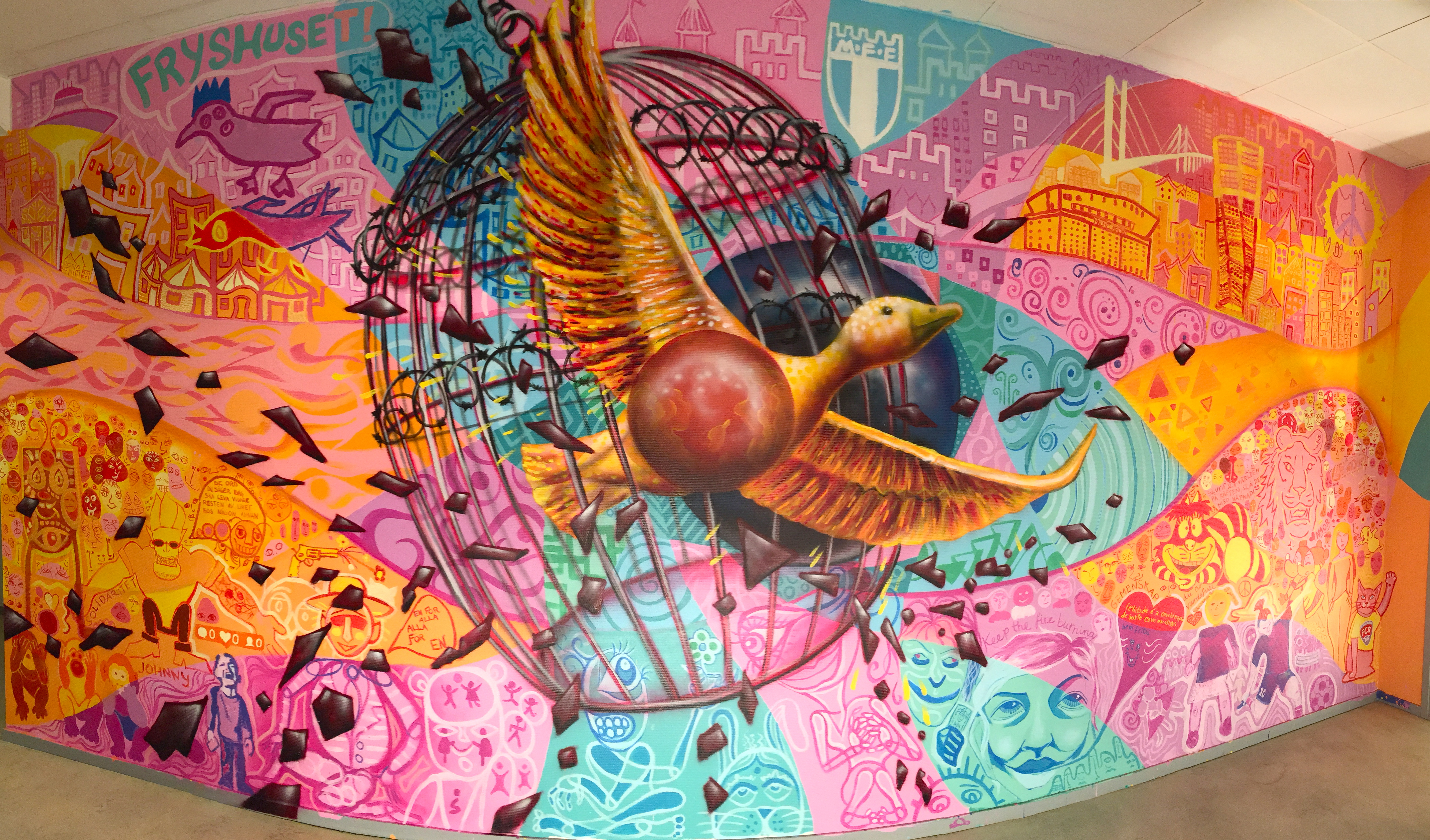
 In August of 2015, I visited Malmö, Sweden for the first of a series of community-based public art projects in five different countries for the #AddColourToLives initiative, which features partnerships between grass-roots youth organizations and local Park Inn hotels. The idea is to give hotel employees, from cooks to room cleaners to managers, the opportunity to get involved in their community by forming long-term relationships with youth in difficult life situations, including recently-arrived refugees, teens from marginalized communities and kids who have been taken from their families. To kick off this initiative, I was invited to organize collaborative community mural projects that would explore issues important to the youth and focus on building positive relations between the participants. In Malmö, our partner was Fryshuset, an incredible center that has programs that focus on addressing issues facing the youth: violence, gangs, extremism, unemployment, social exclusion, gender-based discrimination, and more.
 Upon arriving in Malmö, I expected to see plenty of stereotypical Swedes; you know– tall, blonde, blue- eyed… So you can imagine my surprise when I instead encountered Arabs, Africans and Central Asians. Had I come to the right country? It turns out that Malmö is one of the most diverse cities in Europe thanks to Sweden’s welcoming policies towards refugees and immigrants, with 40% of the population foreign-born. In fact, not one of my youth participants at Fryshuset was of Swedish origin. It was fascinating to meet them and discuss their lives growing up in such a different culture from the ones they came from, which included Iraq, Bosnia, Afghanistan, Palestine, Brazil, Cameroon, Romania, China and more. In our introductory workshop we played games to loosen up and I facilitated arts-based activities. We discussed the issues that they wanted to address in their mural, which was to be painted on the walls of their youth center. Together, we explored topics such as confronting racism, cultivating a welcoming environment for those fleeing hardship, and creating a safe space for those of diverse backgrounds, ideologies and sexual orientations. This last topic in particular caused a bit of controversy, as the young people ranged in their attitudes toward homosexuality, with some passionate about gay rights and others openly uncomfortable with the subject, to the extent that a few threatened not to participate. But in the end they all agreed to join in, and I felt that a small battle for inclusion had been won.

Sketches and reference photos from our first workshop
The central image of the mural was a bird breaking free from a cage, which the young people felt expressed their desire for freedom and a breakdown of traditional boundaries and borders, both physical and mental. The rest of the mural was made up of the reflections of the participants on this subject, as well as imagery that they felt represented them and their communities.
Once we started painting, the teens were highly opinionated about what images would go on the wall, which I was happy to see because it meant they cared about their mural. However, I was surprised by the lack of self-confidence they had in their abilities, and many refused to paint at first! “This is what I want painted in my section; can you do it for me? If I paint it will look ugly,” they would plead. Slowly, the team and I guided the participants in the process of letting go of inhibitions and having fun with art making. In the end, many expressed shock at what they had achieved.
 Most importantly to me, positive connections were made between many of the teens, adults, hotel workers and their families. It was incredible to see people of such diverse backgrounds all working together on a common goal and supporting one another. I also enjoyed speaking to the young people about their experiences. I asked one about whether political and ethnic divisions from their home countries affected them. He responded by pointing to another boy painting on the wall.
“I am Kurdish, so I hate Saddam Hussein,” he told me, in reference to the former leader of Iraq who famously gassed thousands of Kurds to death.
“He is an Iraqi Sunni and loves Saddam Hussein. But we do not discuss this, and we are best friends. We don’t let these things get in the way of our friendship. We focus on everything we have in common.”
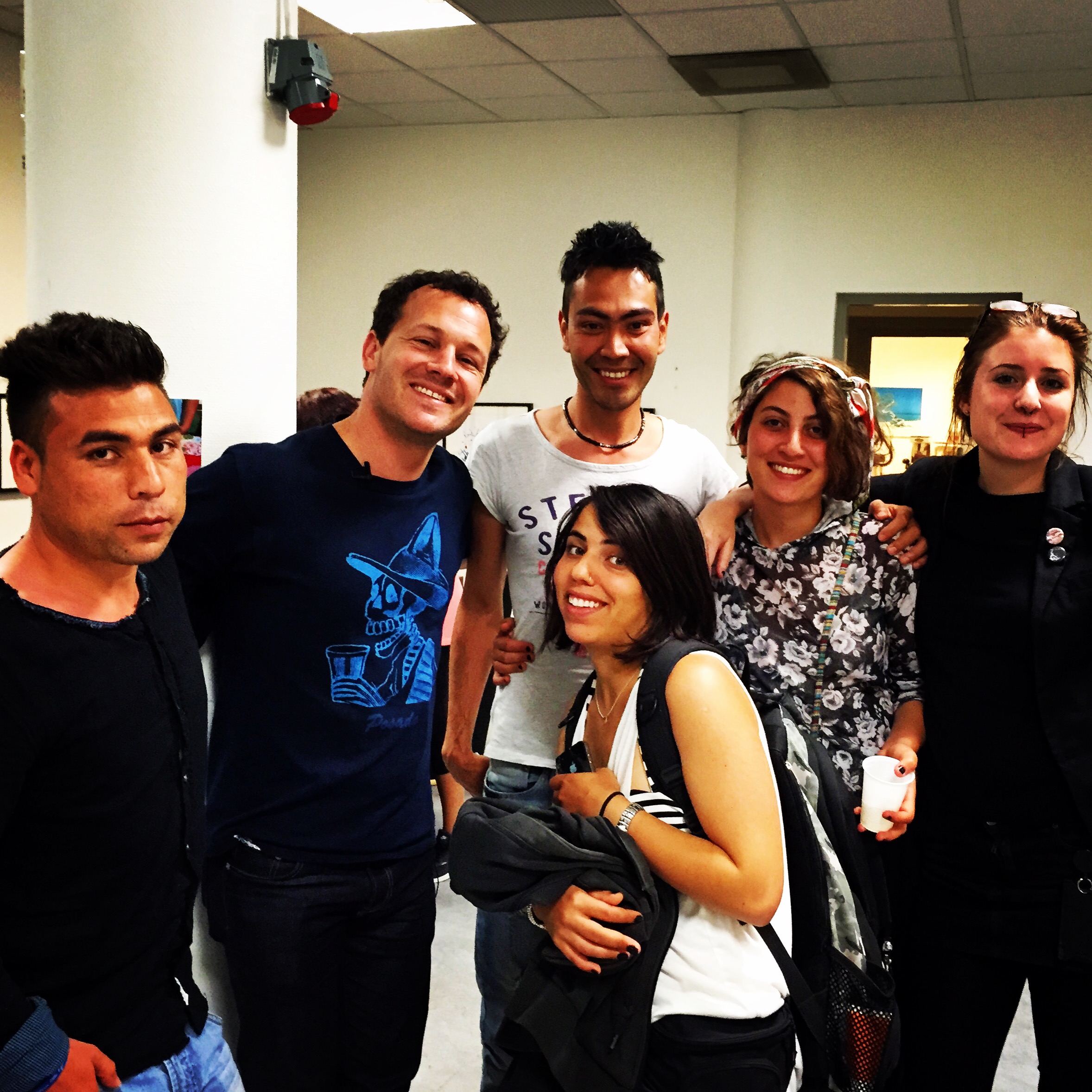
And this, in a nutshell, is what our project is all about. At the closing ceremony, we celebrated our accomplishment with snacks, speeches, and plenty of photos. Thanks to all the youth from Fryshuset for your dedication and hard work! Thanks to everyone at Park Inn Malmö, my partner in crime Carolyn and to the filmmakers Daniel and Yuktesh who did an excellent job documenting the project! Check it out below…


“Ix Chel’s Dream” Collaboration with Chris Soria
Posted on July 23, 2015

- Photo by @slimjim72

This month I had the pleasure of collaborating on a mural with an artist I’ve admired for a long time, my friend Chris Soria. As our approaches have a lot in common, especially our love of layering and patterns, we chose to fully integrate our two styles into one cohesive mural instead of simply dividing the wall into two sections. The location was on Harman Street in Bushwick, Brooklyn. Our piece is the latest to be organized by Spread Art NYC, an initiative led by the Arabic calligraphy street artist and tattooist, Rocko, who has a community-oriented approach to his projects. Many of the murals in the area feature Puerto Rican icons in reference to the local culture. Chris and I spent time considering many potential themes for our mural, but ended up creating a design inspired by the story of Ix Chel, the Mayan goddess who was killed for having a relationship with the Sun God, but was then awoken from death by hundreds of dragonflies. We liked the fact that the story featured a strong female character, as most of the nearby artwork was male-dominated. We also recognized that the Latino population in Bushwick are from many nations, not just Puerto Rico. As various Mayan peoples dominate southern Mexico and much of Central America, it is fitting to have a mural inspired by a Mayan story. As we painted, we were welcomed by the residents, who even brought us cold drinks and sweets. Thanks to everyone on Harman Street and to Spread Art NYC!


Holy Cow! New Mural in Staten Island
Posted on July 15, 2015

When Maria, the owner of Fab Cup Coffee Shop in Staten Island, commissioned me to paint a mural on the large outdoor wall of her establishment, her only request was that it should feature cows. Maria is from Russia, where the rural Siberian scenery she was immersed in growing up always included cattle, leading to a life-long fascination with these animals that give her nostalgia for her homeland. She and her Cuban-Brooklynite husband, Juan, ended up settling in Staten Island, where they have a new baby and a new business: Fab Cup! All that was missing was some artwork for that big blank wall facing a major commercial corridor.
 I admit that at first I wondered to myself, what’s so special about cows that will provide me inspiration for an entire mural? But after a little research, I realized that these are truly significant animals to human history and cultures around the world. From the famous holy cows of India to the Mother of the Sun in ancient Egypt- portrayed as a cow- humans have always found inspiration in these creatures. Due to their milk-producing nature and vital role in farming, many peoples consider cows to be symbols of fertility, Mother Earth, and renewal. I found many interesting photos of cattle to use as references, from the milk cows we are accustomed to seeing in rural America to the long-horned (and very hairy) highland cattle of Scotland; and of course I had to include the cow’s male counterpart, the bull, an animal similarly steeped in symbolism. Thanks to Maria, Juan and the whole Fab Cup crew for the warm hospitality (and excellent coffee and sandwiches) during my four days of painting!


Artistic Noise: Art with Youth in the Justice System
Posted on July 15, 2015

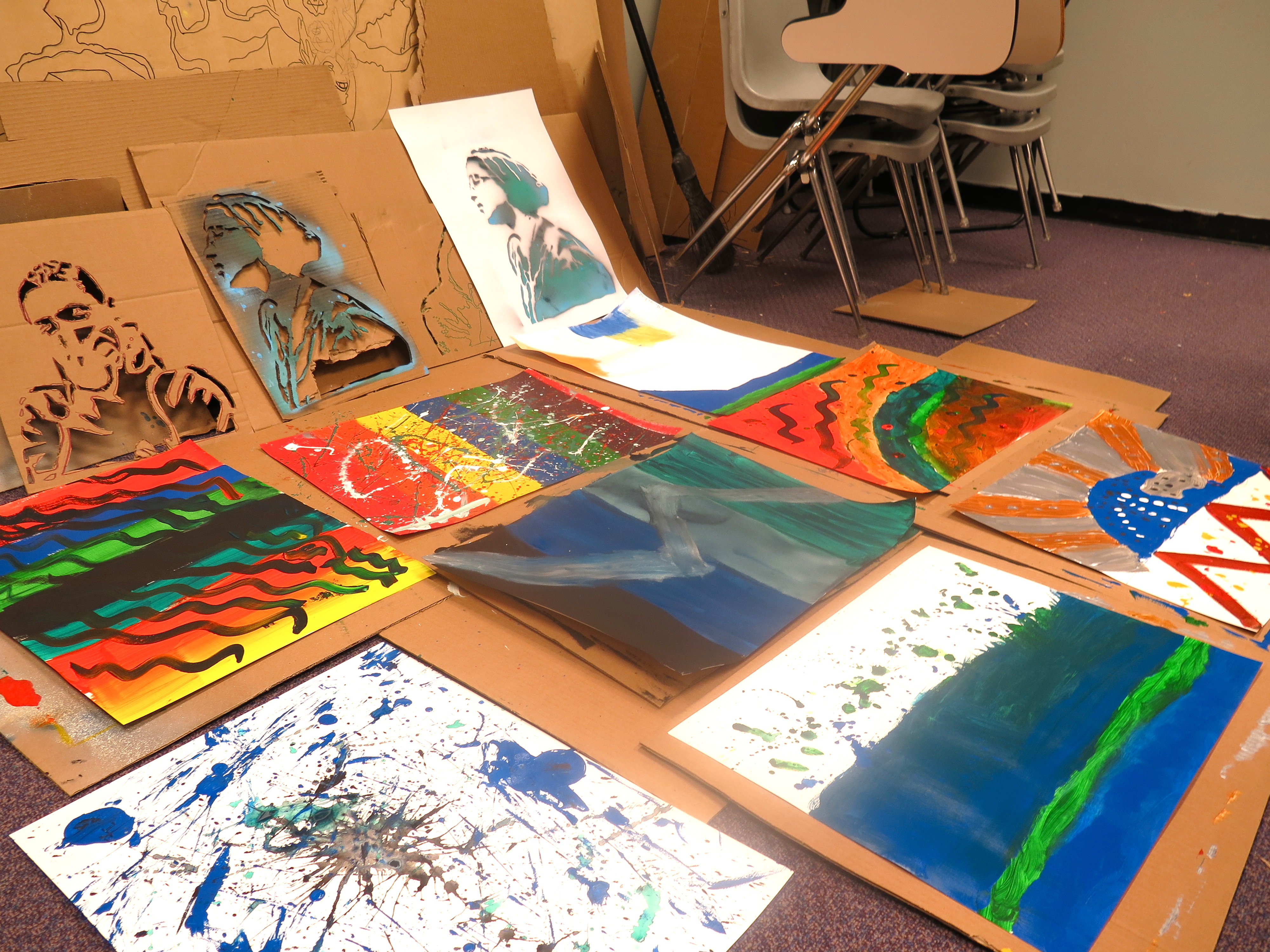
An explosion of creativity in our workshop!
This year, I have been leading arts-based workshops with youth involved in the justice system. Through the organization Artistic Noise, I worked with teens in Brooklyn and Harlem who have recently been in trouble with the law, engaging them in creative activities and the life experience of creating art to be exhibited publicly. Together we had discussions and presentations, went on field trips, made stencils and collages, explored abstract expressionism, painted a mural, made custom T-shirts and learned painting and aerosol techniques. For one project in Brooklyn, the students created self portraits on canvas in which they spray painted their stencils over their own abstract backgrounds. In a second project, we had discussions about what positive achievement each of them would like to one day be known for. This was a question many had not previously considered, assuming that they could only be in the media for negative actions. They glued newspaper collages onto canvas, spray painted their own images on top and then created headlines that they dreamed they would one day see: achievements in the fields of medicine, sports, science and entertainment.
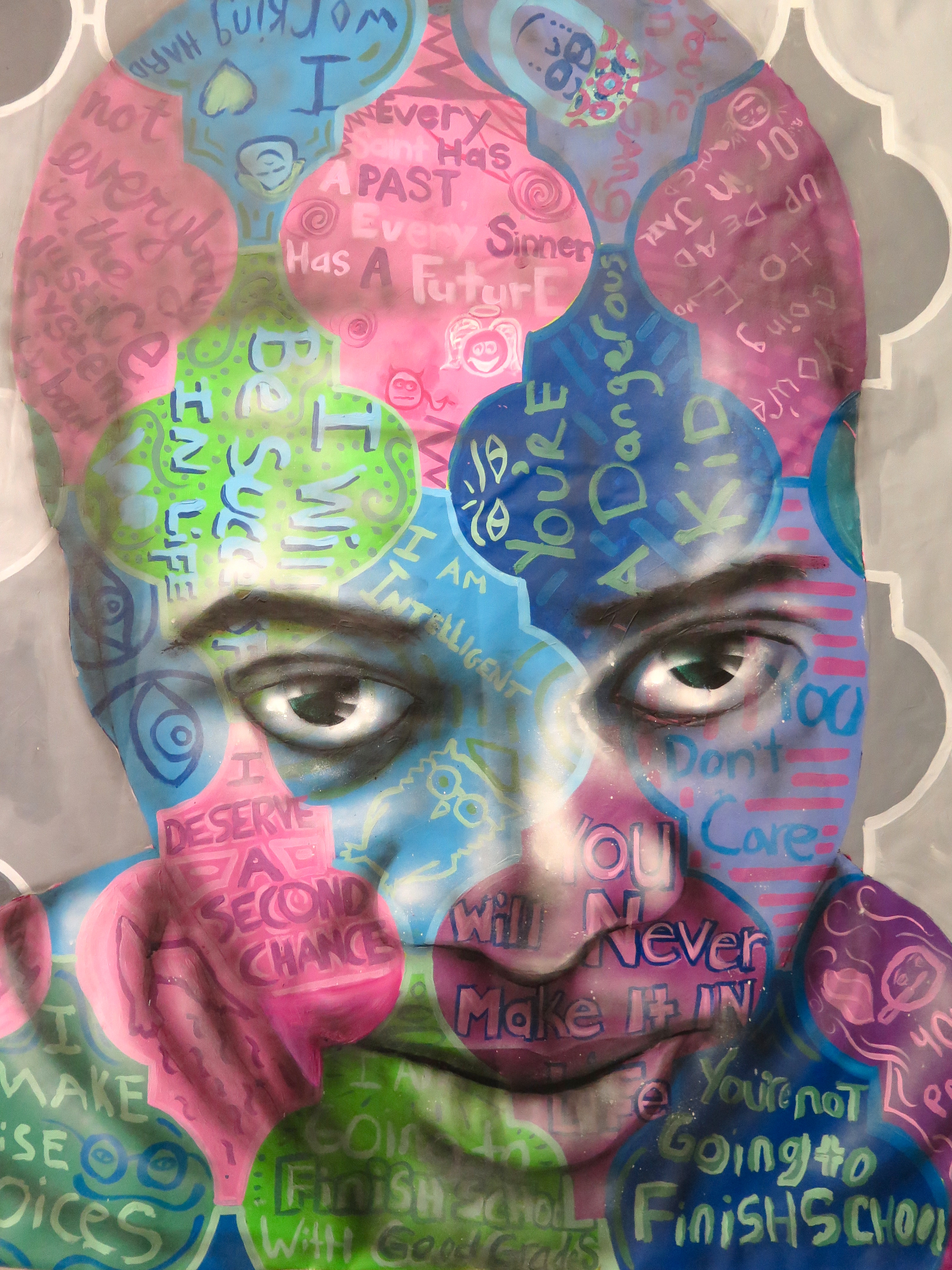
In one workshop in Harlem, the participants came up with a concept for a collaborative mural: the face of a young man would be full of thoughts, with one side featuring people’s negative judgements of them that they struggle against, and the other side including positive statements of self-affirmation that they wished others could know about them. We discussed the racism and stereotypes that these youth face on a daily basis, which they said leads them to feel that society views them as being criminals, drug addicts, uneducated, lazy and uncaring. They expressed that they wanted people to know who they truly are; young men and women with a strong desire to be positive members of their communities and succeed in their educational and career pursuits. We spent weeks working on the mural together, putting all these ideas into it.
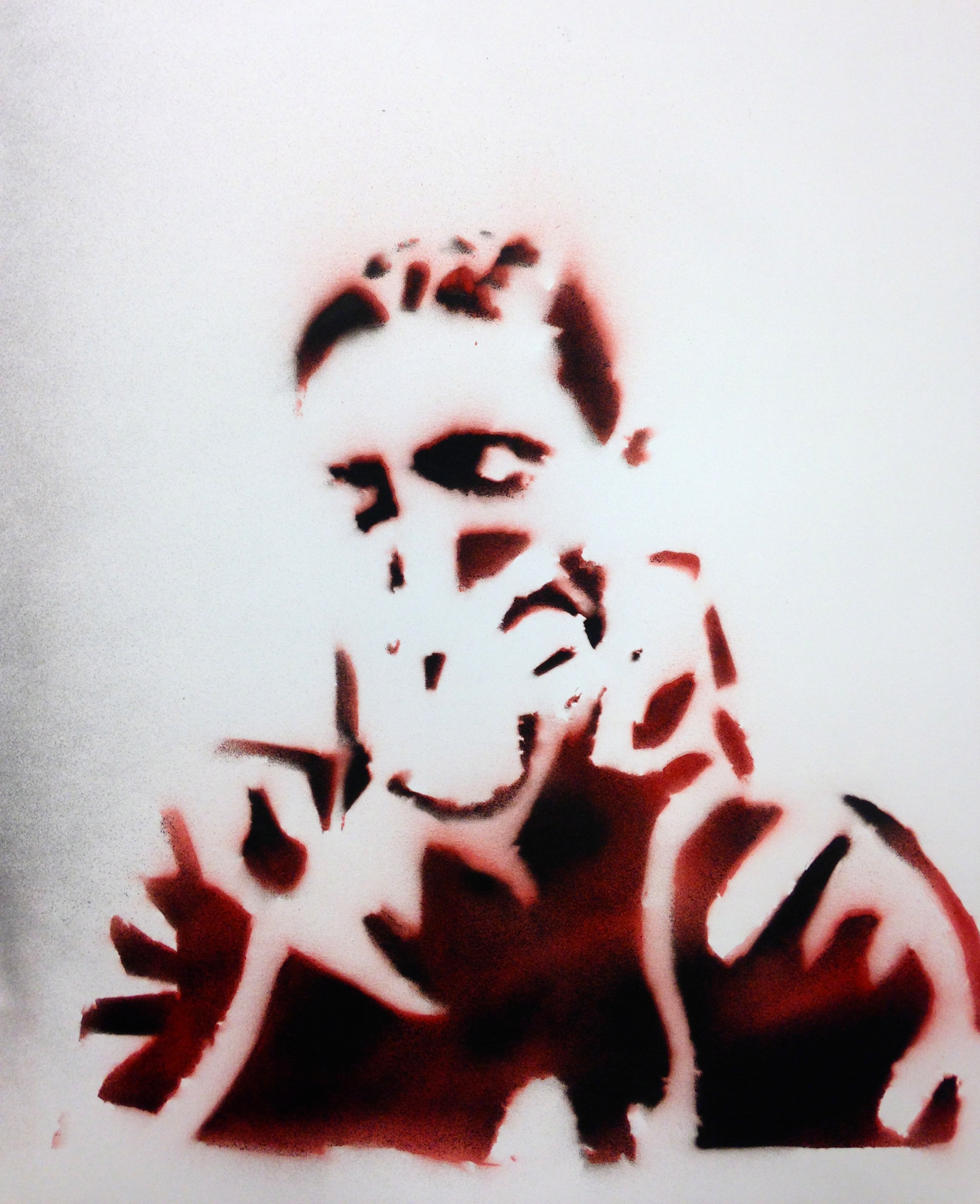
A stencil piece by the student who is now facing a murder charge.
Of course, things didn’t always go smoothly, as there are challenges working with this population. The worst moment came when one participant, who had been doing quite well and was seemingly headed in a positive direction, was arrested for murder. He was well- liked by the group, who were understandably upset by the news. He is still in Rikers awaiting trial. However, the rewards of this work far outweigh the difficulties, as I believe it is this population that most needs positive adults in their lives and creative activities to direct their energies toward. I enjoyed working in partnership with two licensed art therapists, who made sure that each workshop included therapeutic elements. It is amazing to see kids open up about their lives while making art in a way that they may not have been comfortable doing in a traditional therapist’s office. One 17-year old boy disclosed that he was stressed because he his girlfriend was pregnant, exactly the situation I had found myself in at his age. I was glad to be able to share my story with him and let him know that while being a parent is especially challenging at that age, it can also be an amazing experience and one that does not need to disrupt one’s life dreams.
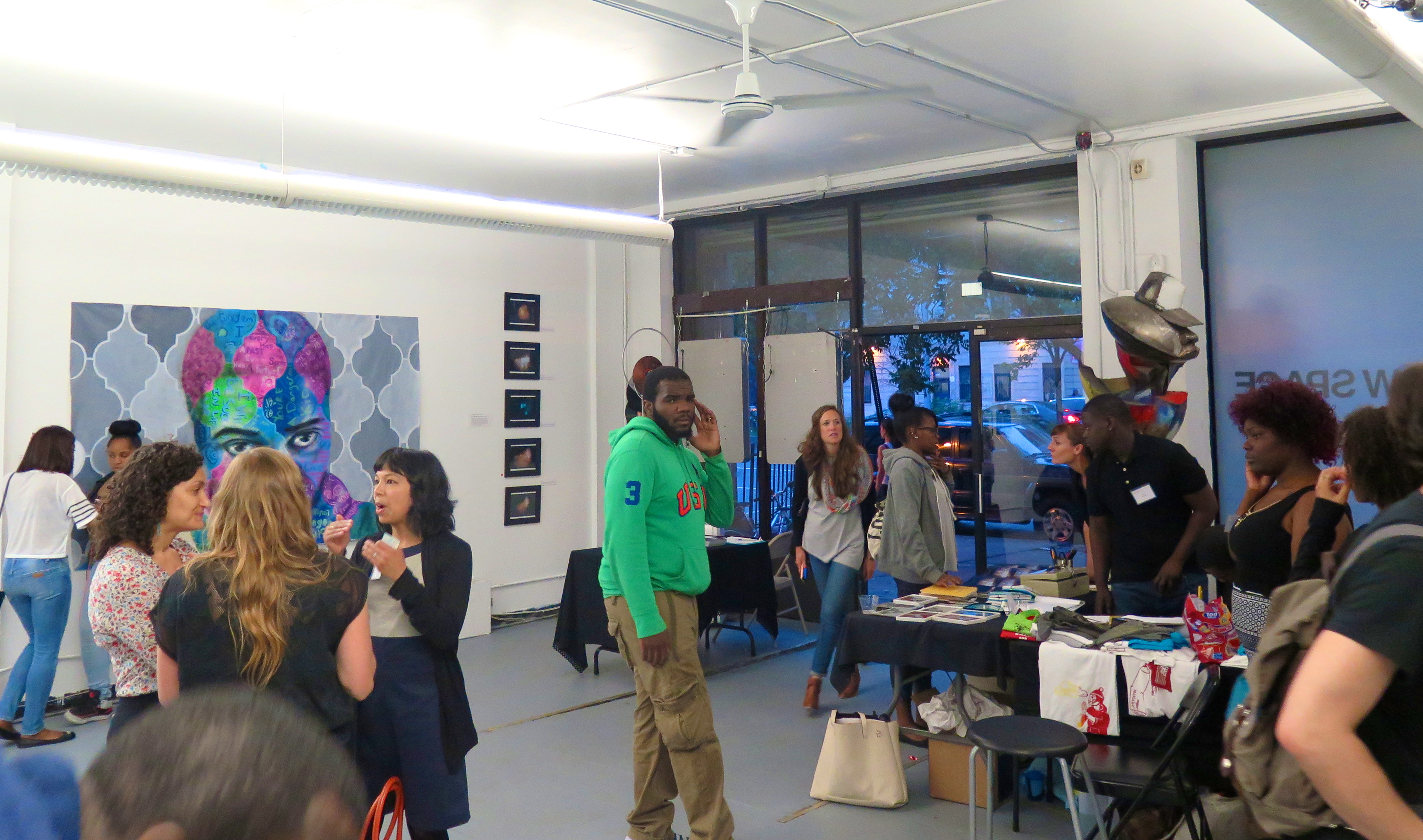 After four months, we headed to the annual Artistic Noise exhibition in Harlem, in which works of art by dozens of court-involved young people were displayed for the public to experience. My participants were blown away; there on the walls were their creative expressions, exhibited professionally with a crowd of people from all walks of life admiring them! Many of the pieces were sold, to the delight of the young artists. What an experience for a teenager to have! Even better, some of the organization’s most dedicated participants had paid jobs in which they curated the show and created artwork, learning many skills along the way.
I am currently planning future arts-based projects with youth and adults in the court system, including those who are currently incarcerated, as I believe our justice system is broken and fundamentally unjust. Through the arts and advocacy, these issues must be brought to the light and humanized in order for us to have a long-overdue societal dialogue.


Palestinian- Israeli Art & Dialogue
Posted on June 7, 2015
 I recently got back from the ancient land of Israel/ Palestine, where diverse peoples claim the same tiny slice of our planet and have been unable to resolve their conflict to this day. While politicians fail to find solutions year after year, ordinary Jews and Arabs generally live separate lives and fear one another, even when they live close together. While some believe these two groups cannot coexist peacefully, a brief glance at history shows otherwise. Jews were an integral part of Muslim societies across the Middle East and Northern Africa for centuries, and for most of that time the two lived in peace as neighbors; much more so, in fact, than either group experienced with Christian Europeans. Over half of the Jews in Israel today are descendants of these communities and it was sometimes impossible for me to distinguish between them and Arabs, as they share both physical characteristics and cultural heritage. While the current political climate does not bode well for a resolution of the conflict in the near future, many ordinary people are organizing grassroots initiatives to end the cycle of violence, hate and fear.
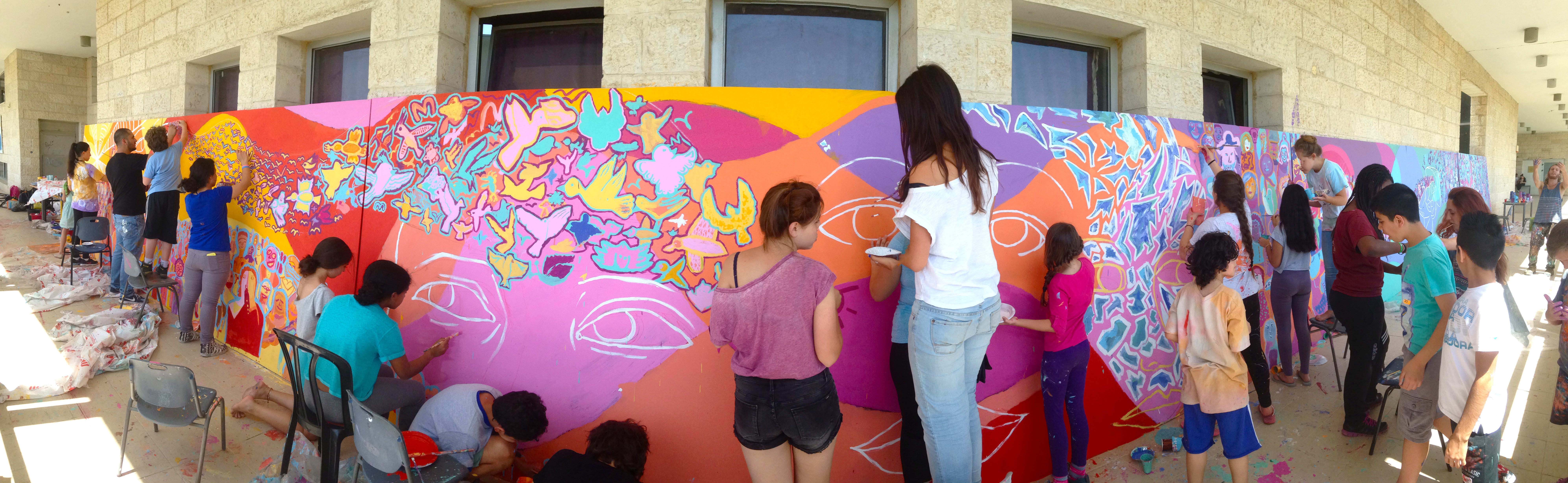
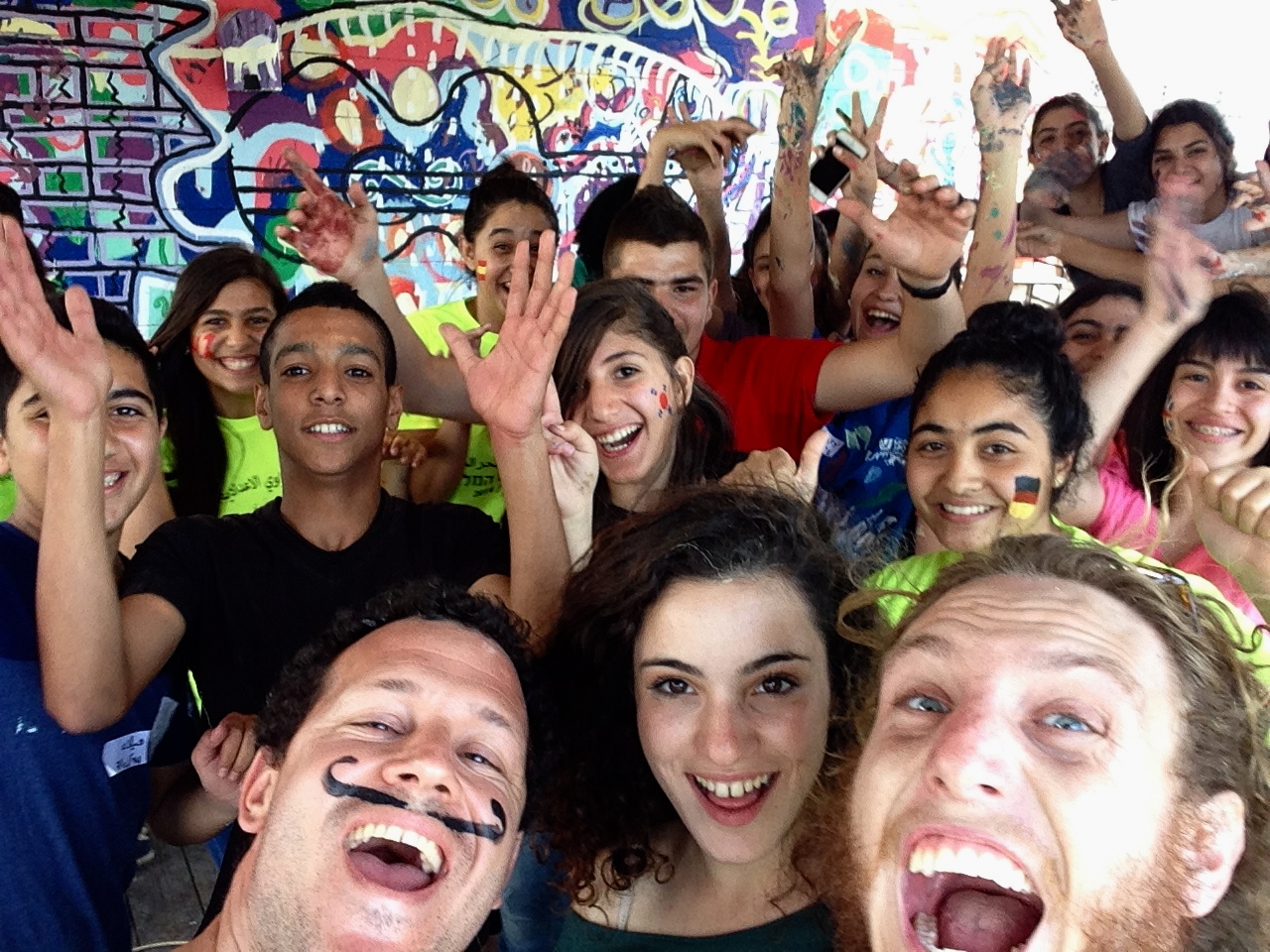 Taking inspiration from such initiatives, I partnered with fellow US-based artist and educator Max Frieder and his Artolution initiative to facilitate a series of community-based mural projects with Arab and Jewish young people, many of whom had few opportunities to interact. With support from the US embassy and consulate, we visited communities across Israel and the West Bank to meet people and learn about this fascinating but complex region. We collaborated with local organizations and schools to lead workshops with youth in which we would explore issues important to their lives and the value of bringing together diverse peoples. The students were introduced to the murals of other young people around the world who had participated in similar projects, which was an inspiration to them. Excited, they came up with dozens of ideas for their own mural. As a collective group of Jews and Arabs, they worked together to organize all their ideas into one cohesive mural design, and then painted it as a team.
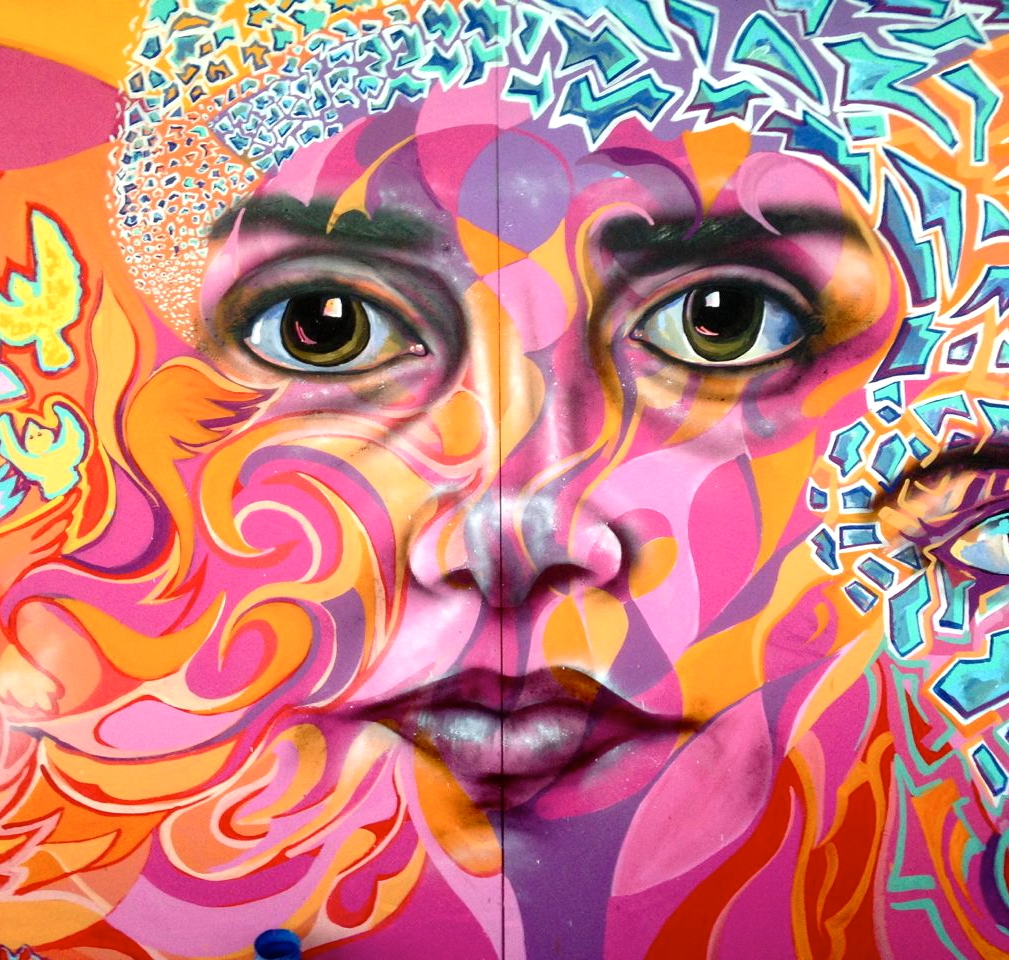 One of the groups came up with the image of a boat floating on a sea. Out of the boat grew a tree with branches that became human figures. They wanted to send a message that despite their differences they all had the same roots, and that they were all on the same boat together. Another mural in Jerusalem told a story of the journey from disunity and conflict to peaceful coexistence, reflecting their desire to make this journey a reality in their region. While these values may sound obvious to outsiders, it is highly controversial in the Middle East. The school where we worked in Jerusalem, Hand in Hand, is the rare example of an institution where both Arabs and Jews study together. It recently suffered a vicious arson attack carried out by Jewish extremists, illustrating how intensely some elements in society oppose coexistence. The mural we created there was then installed on the outside area of the US Consulate, where people of all backgrounds must wait together in long lines together when applying for visas.
 As we worked together, I was struck more by what united our two groups than what separated them. They were both teenagers after all, laughing nervously when around the opposite sex, singing along to the same pop songs and, at the end of one day of painting, they all broke out into a spontaneous dance party, with everyone dancing together to songs in Arabic and Hebrew. Of course, at the end of the project they would each return to their communities and things would not be so simple. After all, it is not easy to forgive when loved ones have been killed by members of the other side or a family’s ancestral home has been taken. But we hope that through many projects that bring the two communities together, there will slowly be an opening up, an understanding of the other’s perspective even if there is not agreement. I felt hopeful listening to many of our students’ words after these interactions; they noted that they had always been taught to fear the other, but that now they had made new friends and had a new perspective. Our goal going forward is to train local Israeli and Palestinian artists and educators to continue these public arts-based projects in order to bring new generations of youth together for dialogue, cooperation and friendship.


Brooklyn is the Future
Posted on June 6, 2015
I recently had the opportunity to paint two murals for Brooklyn is the Future events; one in Bushwick and the second, called “Writing on the Walls,” in Brownsville. Thanks to both of these communities who made me feel welcome; curator and artist (and Brownsville native) N Carlos J for inviting me; the event sponsors, Brooklyn Arts Council and Liquitex Paints; and to my partner in crime, CJ Thomas aka Karlinha das Pinturas!


Exhibition at the United Nations Headquarters!
Posted on April 22, 2015
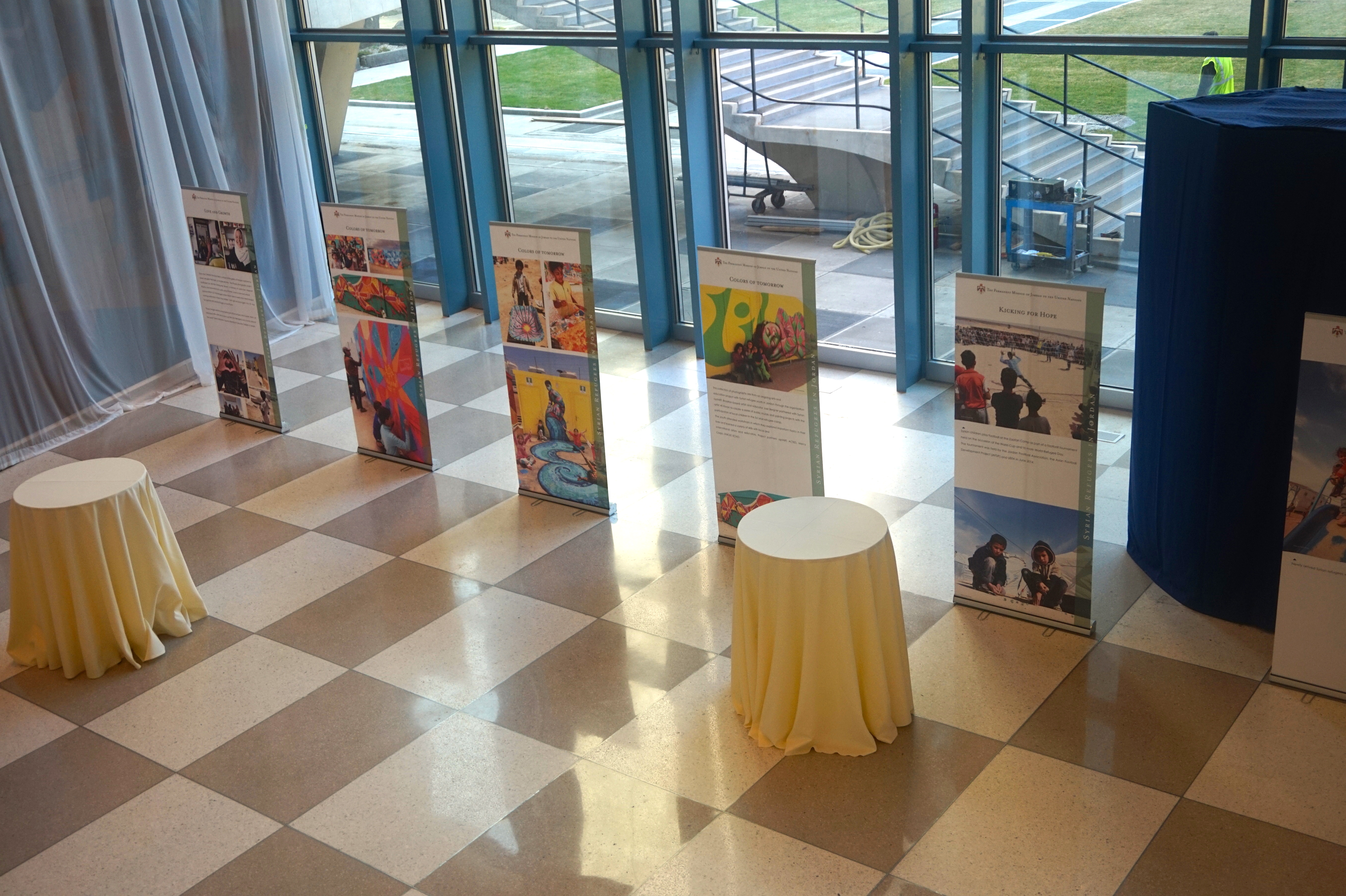 I was honored have photography that I took of my arts-based community work with Syrian youth exhibited at the United Nations Headquarters in New York City. I have traveled to Jordan three times with the organization aptART to work in refugee camps and host communities. Partner organizations for these projects were ACTED, Mercy Corps and UNICEF. Thanks to the Jordanian mission at the UN for including my work in the exhibition and for inviting me to the opening reception, where I had the opportunity to meet the ambassadors of Jordan, Venezuela and the US and discuss my work with them.


The Warriors! East Harlem youth mural project
Posted on April 22, 2015

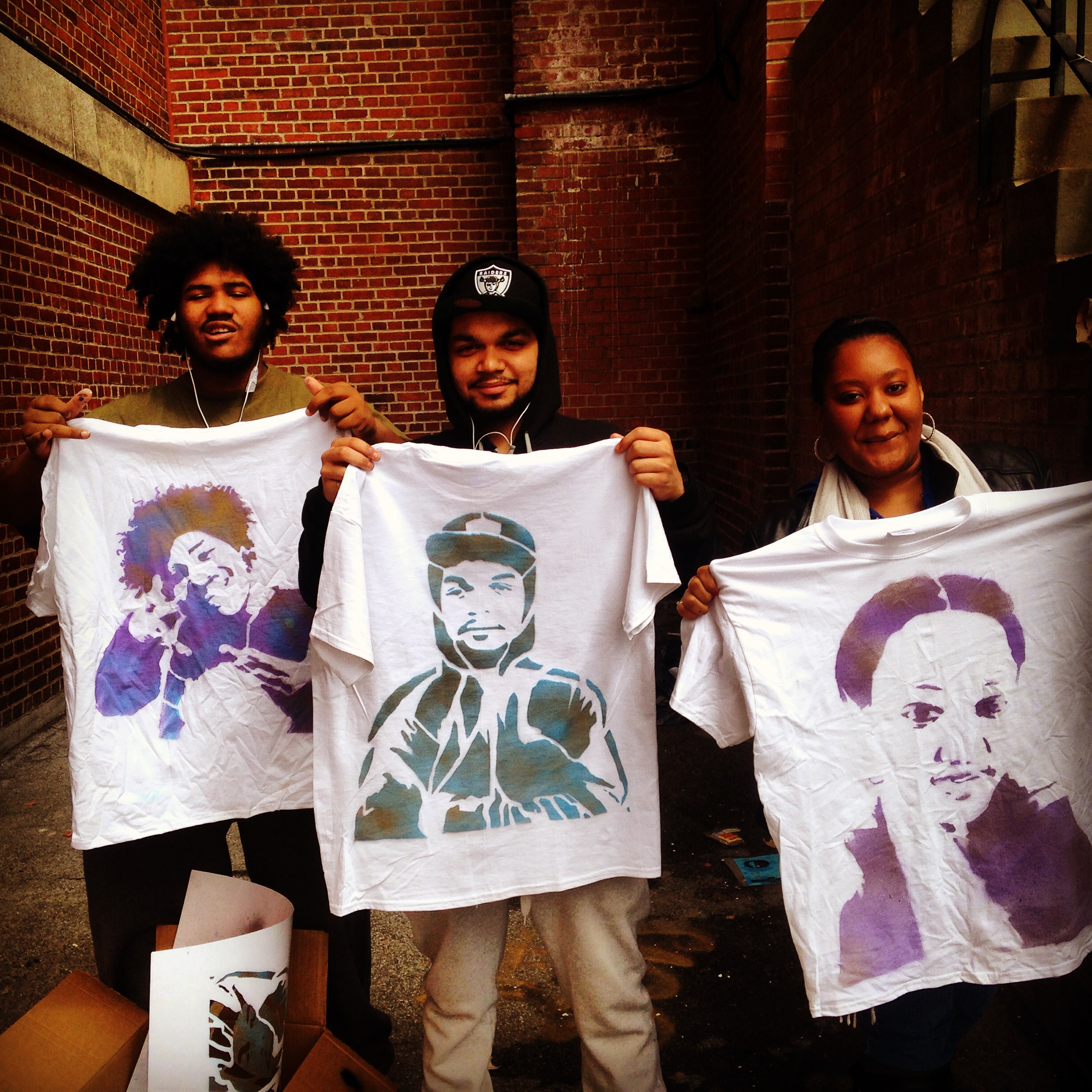 I spent an incredible two weeks at Innovation High School in East Harlem for their intensive enrichment program. I worked with students and staff to create a mural in the school that featured warriors from a variety of cultures around the world, both male and female, in reference to the school’s mascot. We studied public art, went on field trips to see murals and museums all around NYC, created stencils, made T shirts, and visited legendary graffiti artist Angel Ortiz (LA2) in his studio. Thanks to everyone who participated and to the school for inviting me!


A chilly reception in Jordan: Syrian Refugee Project part 3
Posted on February 20, 2015

Syrian and Jordanian youth participants
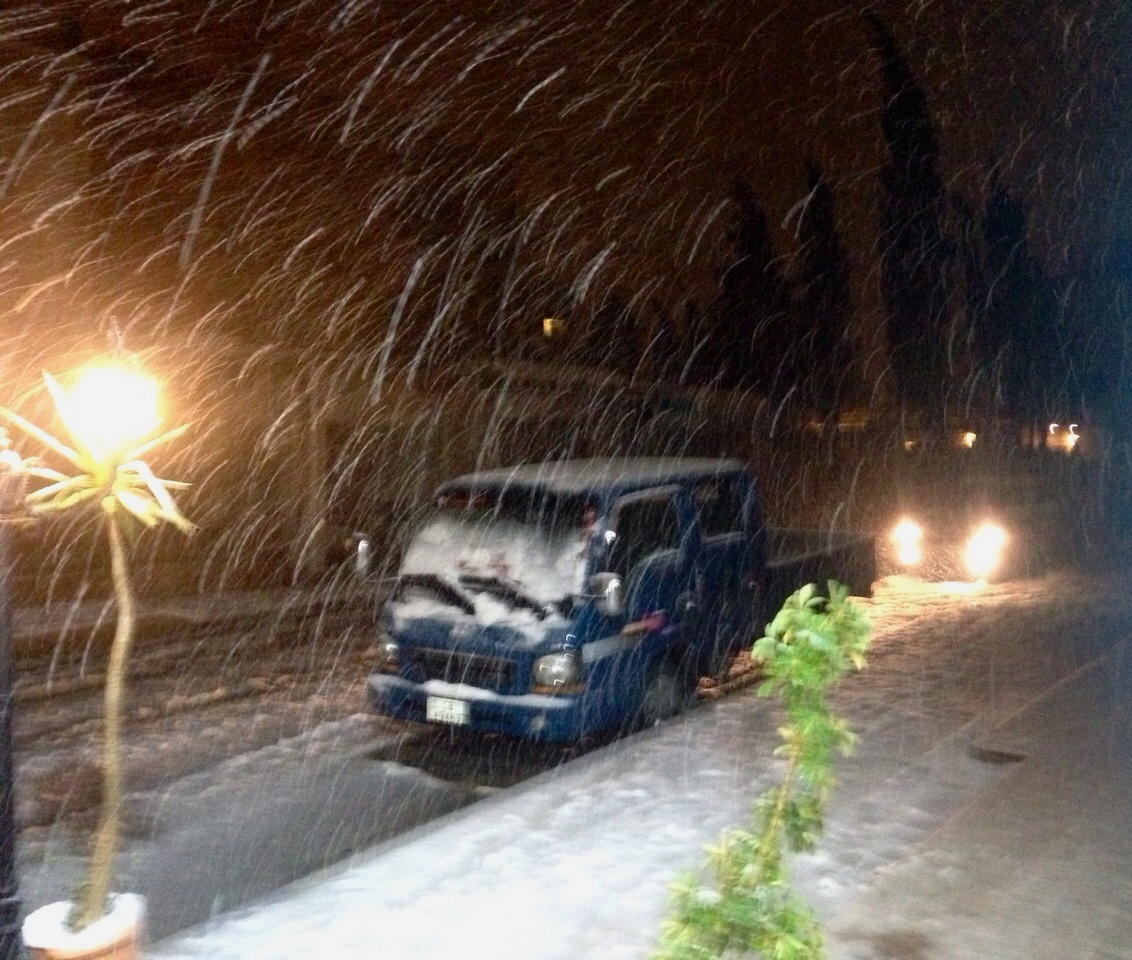 Upon arriving in Jordan, I was anxious to get started on my third series of projects with Syrian refugees in the past year and a half. But the weather had other plans for me; the night of my arrival, the region was engulfed in a rare snowstorm and I spent days waiting for the country to thaw. While it seemed impossible for me to escape the cold—buildings in Jordan are generally made of cinder blocks that have no insulation and no heating beyond space heaters that don’t seem to fill a room, making it so cold that I could see my breath in my bedroom—I couldn’t help but think of the millions of people displaced by conflict around the Middle East, living in refugee camps and temporary settlements that I imagine are colder and much more desperate than regular housing in the capital.
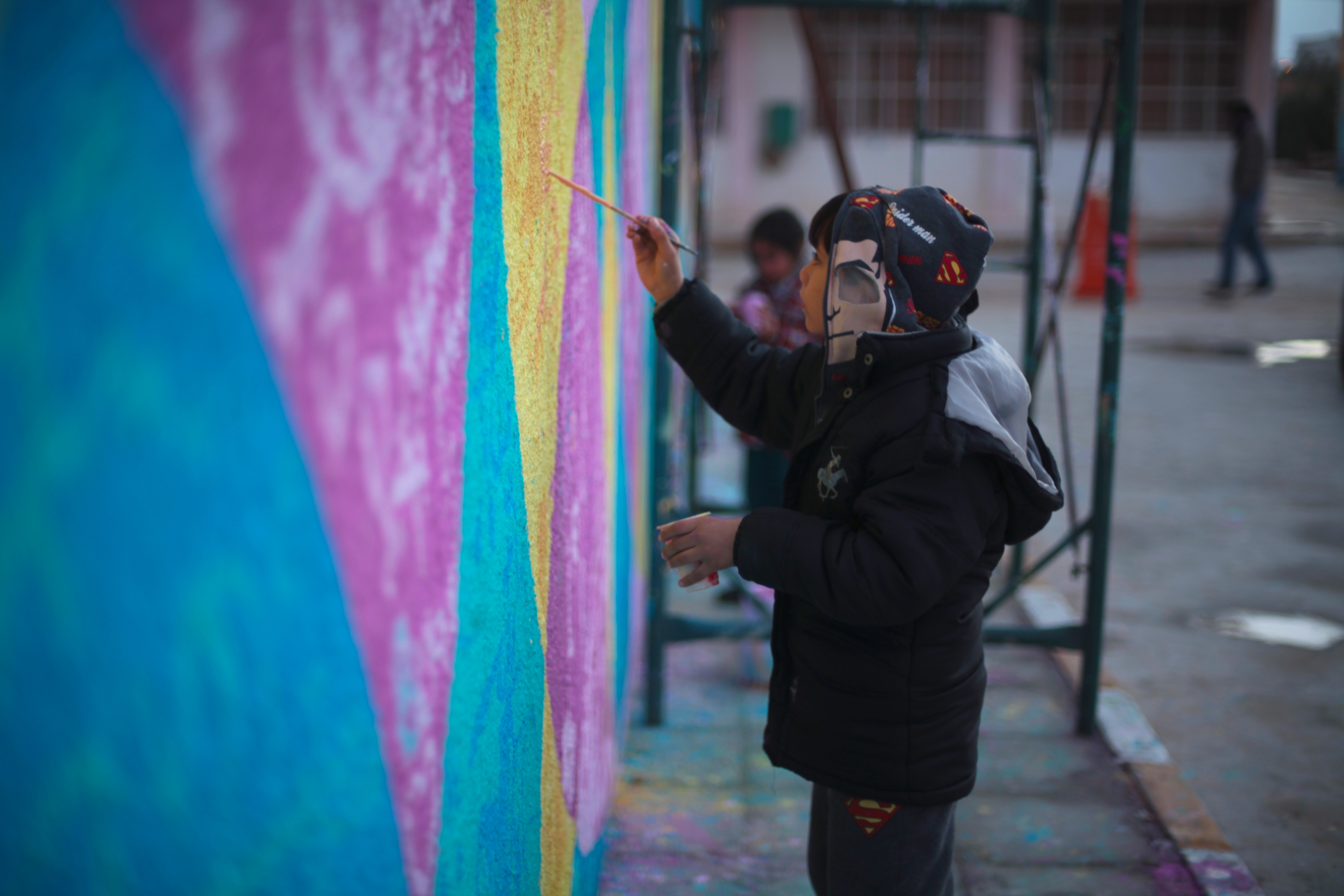
Child participating in the mural project. Photo by Samantha Robison.
Finally the weather subsided and I once again joined forces with AptART (Awareness and Prevention Through Art), Mercy Corps and UNICEF to facilitate two more mural projects with Syrian refugee youth. The first took us a school in the Bedouin community of Za’atari Village, right next to the refugee camp of the same name that I worked in during my last two visits. The project aimed to bring together local Jordanian kids and their recently-arrived Syrian peers to participate in workshops and create a giant mural together. There has been tension and animosity in the school between these two groups, which is a reflection of the situation in host communities across the region that have all experienced massive waves of refugees fleeing the Syrian Civil War, putting intense strains on local resources, social services, employment and housing. The kids and teenagers discussed the importance of unity and cooperation between the two populations in their village, and expressed their ideas through writing and paintings on the wall.

A Syrian teenager expresses her dreams in the water of this mural in Azraq refugee camp.
For our second project, we headed to the Azraq refugee camp, where we painted a mural in an “Adolescent Friendly Space” run by Mercy Corps. We organized workshops with teenage boys and girls in which they explored their lives in Syria, how their goals and outlook on the future has changed due to their displacement, and what they dream of for their lives and for their families and nation. The mural features a boy fishing off of his camel, with the words “One day I will catch my dream” behind him. His fishing line goes into a pond on the cement floor of the space, where each participant painted their own fish filled with images and words that reflected their hopes for the future.
While this visit was much shorter than my time here last year, I once again learned a great deal from our community partners and the kids, whose resilience and upbeat spirit in the face of such unspeakable violence and pain always surprises and moves me. I hope to continue to have the opportunity to come to this region, improve on my Arabic and build more bridges with the Syrian people who, despite having suffered greatly, still have so much to offer and will need all the solidarity they can get as they strive to rebuild their lives and communities.


Here are some highlights from my 2013 and 2014 projects in Za’atari Syrian Refugee Camp (partners: aptART, ACTED, UNICEF, Mercy Corps, ECHO):


Felipe’s Story pt. 3 at DC’s BloomBars
Posted on December 6, 2014
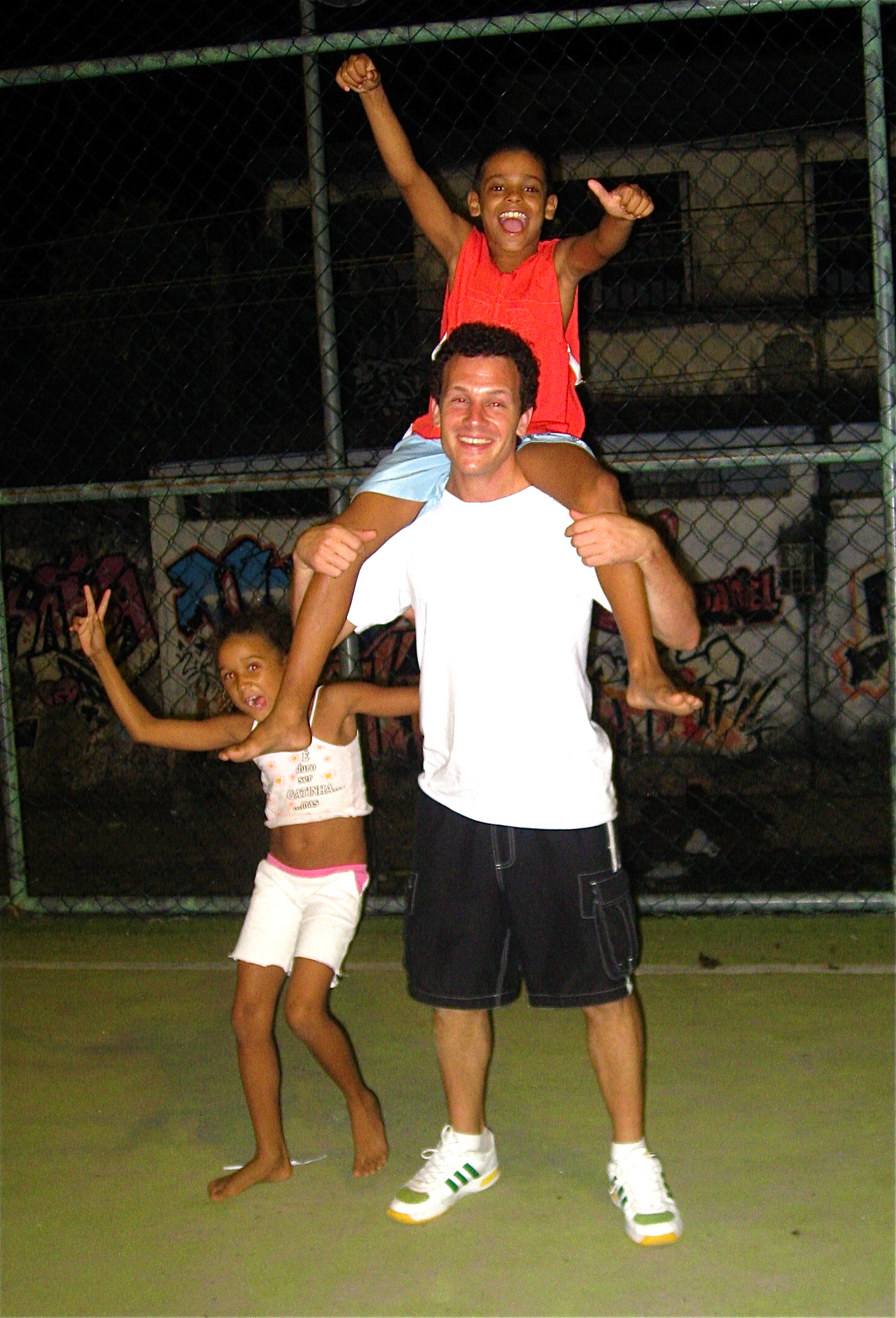
Joel, Felipe and his cousin Julia in 2009
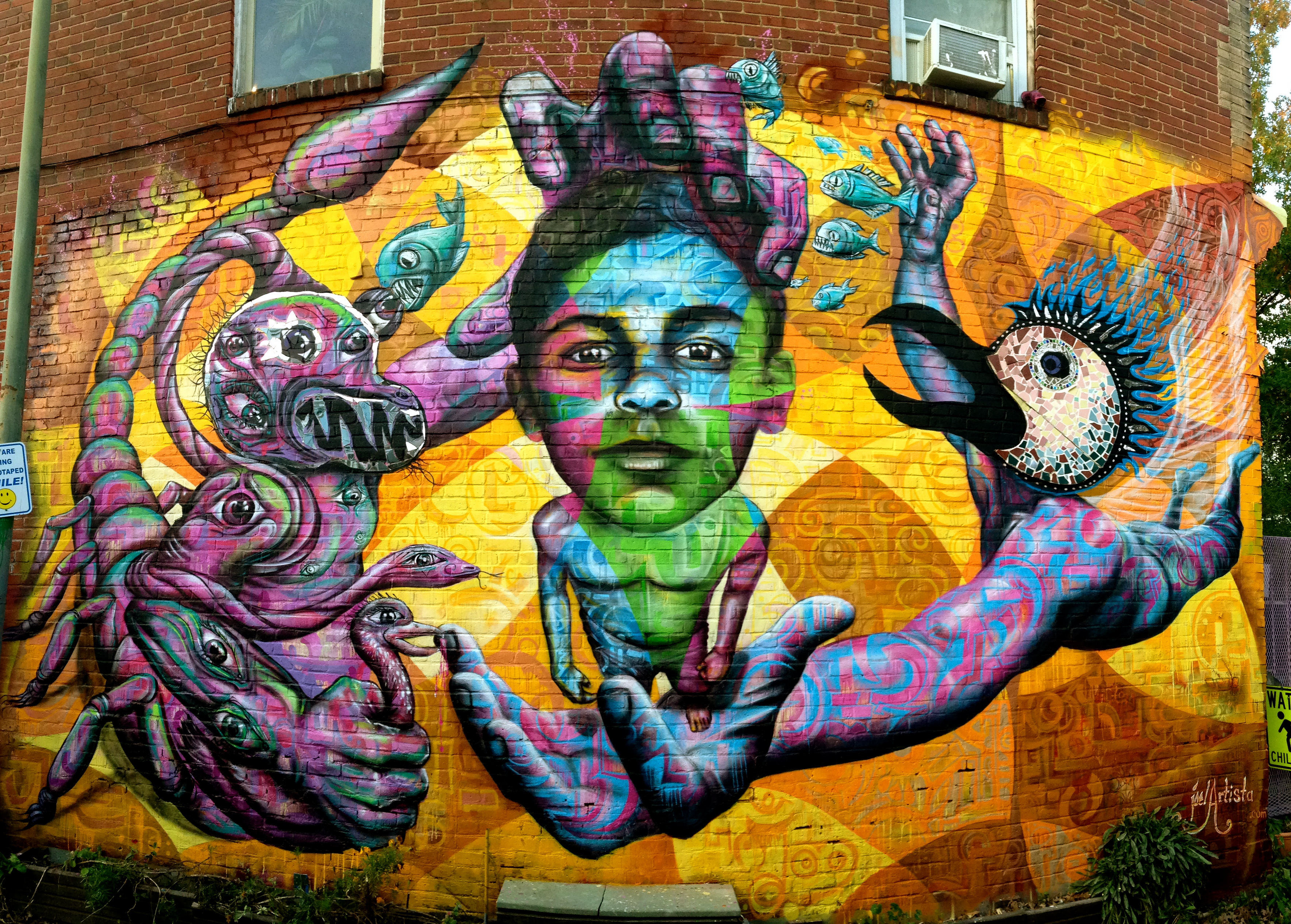
I recently painted the third version of “Felipe’s Story,” the mural that has been on the side of the Washington, DC arts and performance center BloomBars since 2009. That year, I spent time living and working in the slum community (favela) City of God (Cidade de Deus) in Rio de Janeiro, Brazil, which was made infamous from a film of the same name. My host family included an 11 year old boy named Felipe, who I quickly became close with, in part because he was in desperate need of father figures in his life after his dad was killed and he was being raised by his grandmother in an all-female household. I was struck by the extreme situation that this good-natured, playful child was in; his grandmother expressed her worry to me and explained how many kids in the neighborhood, including several of her own children, got sucked into the crime and drug underworld which so often led to death, prison, or addiction. She prayed that Felipe would follow the path of education and a positive life. I realized that this was the story of thousands of kids in Brazil and millions across the world, and when I returned to DC, where I was living at the time, I approached the founder of BloomBars, John Chambers, about turning this concept into a mural with Felipe as the main character.

Joel has been visiting Brazil since 2005 to organize social arts initiatives with favela and street youth, participate in urban arts festivals and spend time with friends in communities in Rio de Janeiro, Salvador, São Paulo and Brasilia.
In the five years since then, my artistic style has changed dramatically and I have had the opportunity to organize arts-based social projects with youth in marginalized communities around the world in collaboration with local organizations. My work has taken me to a Syrian refugee camp in Jordan, an indigenous village in Mexico, a shantytown in Nairobi, Kenya, and many more. All of this has influenced me as a person and an artist, and I am grateful to be able to continuously update the mural at BloomBars with new experiments and ideas. I have also repeatedly returned to my work in Brazil, where I have watched Felipe grow into a young man. Unfortunately, many of his grandmother’s fears have begun to come true. He was locked up last year for robbery and his cousin reported seeing him at a party with a gun. One evening I ran into him as he was on the corner with red-eyed drug traffickers with whom he now associates, an awkward encounter for both of us. Still, all is not lost. Felipe’s family and his girlfriend are positive forces in his life and are attempting to influence him to take a more positive and healthy path. This is a choice only he can make.

Joel, Felipe and his friend in 2013
This new version of “Felipe’s Story” features a 17-year-old Felipe in the same pose as the past murals. There are two creatures struggling over him; one a demon and the other a winged bird-man who wants to guide Felipe in the right direction. As they battle to influence him, Felipe stands still, trying to figure out which way to go and what to do with his life. The artwork includes aerosol art, mosaic, a circular pattern that I saw on a sidewalk in Jordan,and creatures that I invented but which are influenced by many ancient mythological traditions. Thanks to BloomBars for giving me the opportunity to share my art and the ongoing saga of Felipe as it unfolds.

Cidade de Deus (City of God) community in Rio de Janeiro, where Felipe and his family live. Joel has led many community art projects with local youth through the community organization ASVI and the support of the Paróquia Cristo Rei.
London & Vienna
Posted on September 24, 2014
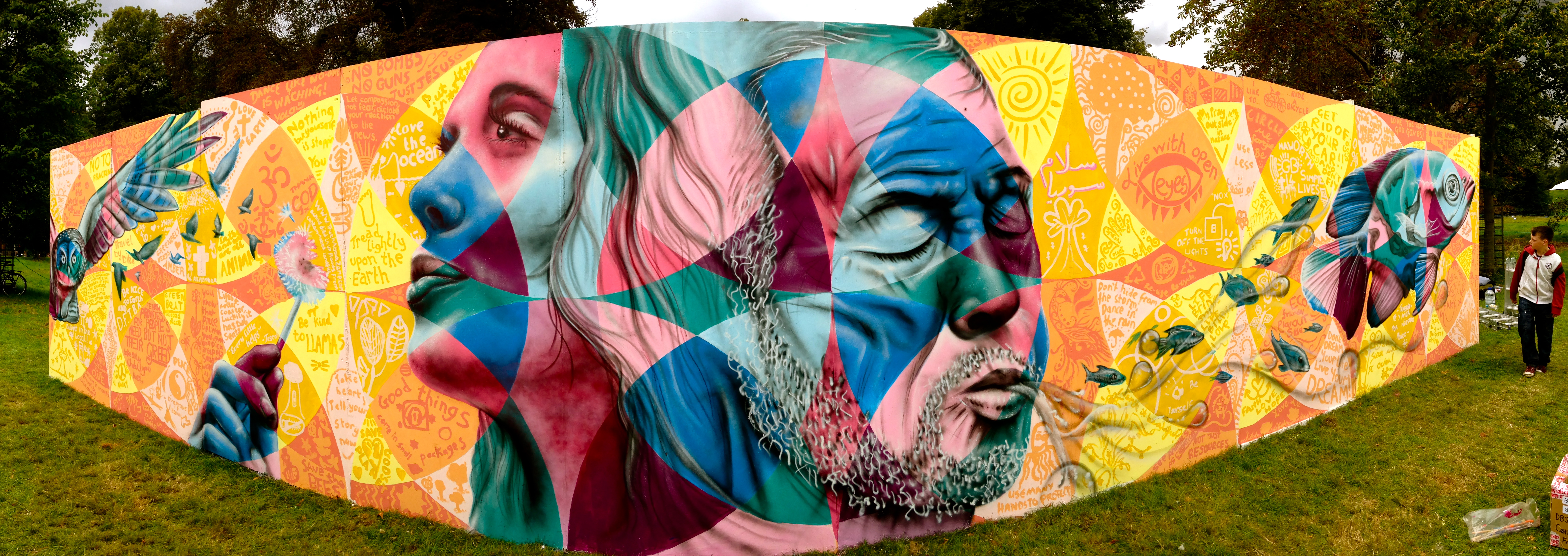
 In August, I spent 4 days at the Greenbelt Festival outside of London, which focuses on progressive social causes, music and art. I worked with a group of volunteers to create an interactive mural on a long wall in the entrance of the event, and we welcomed festival- goers to participate in the creation of the piece by adding their poems, drawings and messages on the colored geometric shapes. The theme was the environment; participants were asked to reflect on what we— as individuals and as communities— can do to begin the healing process and reverse the damage done to our natural environment. The wall quickly got filled up as enthusiastic people of all ages and from a variety of countries and ethnicities got inspired to add their voice to the wall. Everyone seemed passionate about at least one aspect of this issue, whether it be the pollution of our water and air, the dramatic effects of climate change, the shocking rate of animal species becoming extinct, the cutting down of rain forests or many others. It was amazing to see small children painting with their parents and elderly people participating alongside teenagers, everyone excited to be part of the creation process of a giant work of art. Thanks to all the volunteers, participants and the organizers of Greenbelt for welcoming me and supporting the mural project!
After the festival, I got to work on a new series of pieces on canvas in London. I also headed out to Vienna, Austria, where I was invited to the Levin Jam urban arts festival. Thanks to the Levin Statzer Foundation and my friend Isabella Schrammel for hosting me!


Project Jericho: Peace-building with court-involved teens
Posted on July 14, 2014

Project Jericho, an organization that uses the arts to engage court-involved young people in central Ohio, invited me to facilitate the creation of a giant mural that featured the participation of 75 students, including teens recently released from juvenile detention, current inmates, those on probation and also children who are involved in the YMCA, where the mural was painted. The participants used poetry and painting to reflect on violence in their community and the importance of the youth taking a leadership role in the struggle to cultivate a peaceful and positive environment. This project was the culmination of months of workshops in which the Project Jericho teens participated in activities such as dance, drawing, theatre, music and performed at a public event.


Refugee Camp Art: the Za’atari Project 2014
Posted on June 25, 2014
 On a blazingly bright Tuesday morning in Za’atari Syrian Refugee Camp, I met with my team of fellow artists and educators to plan for our day of workshops and mural painting with children. My friend Hamed, a Syrian who works as a hygiene promoter in the camp, told me of his pain to learn that a close friend of his had been killed fighting the government. He showed me pictures of a young, handsome man who had studied chemistry with Hamed at university, earning his masters degree and embarking on a promising career, only to become caught up in the brutality and tragedy of war. Later that morning as we were painting with the kids, one of our most dedicated young artists, a 12-year-old boy named Eyud, pulled back his long sleeves to reveal horrible disfiguring burns on his arms and leg. He told us how agents of the Assad regime, angry that his father had defected from the army to join the rebels, had electrocuted him, scarring him physically and emotionally for life. Looking at this quiet boy with a sweet demeanor, it was impossible for me to wrap my mind around the evil of this act and understand how thousands of such tragedies could be happening right in front of the world’s eyes every day.
  As millions of Syrians have fled to neighboring countries, they have been greeted by international humanitarian organizations that provide food, shelter, medical care and other basic services. But what about education, jobs, activities for youth, poverty and mental health issues? There are many complex questions that do not have easy answers; many problems that do not have simple solutions no matter how much aid money is thrown at the crisis. With the goal of improving the lives of children in the enormous Za’atari refugee camp in northern Jordan, I recently collaborated for the second time with the organization AptART and local artists and educators on a community-based Street Art and education project supported by ACTED, UNICEF and ECHO. Together, we led workshops with kids in which they learned about water conservation, hygiene issues in the camp, artistic techniques and conflict resolution. Through discussions and art, they explored social issues, their longing to return to Syria, their dreams for the future, and their plight as refugees. Dozens of children had the opportunity to participate and add their own creativity to murals that we created throughout the camp, adding color and life to the desolate environment and spreading messages of hope to camp residents.
  For me, one of the biggest benefits that this project has had has been involving local artists who can then continue the work once outsiders like myself have left. One such artist is Yusra Ali, a Palestinian woman who lives in Mufraq, the town right outside the camp. With her upbeat personality and a talent for mixing her love of art with working with children, she has had a huge impact on all of us and has already begun leading arts and education workshops outside of the project. Another star was Ali Kiwan, a soft-spoken Syrian artist and resident of Za’atari who specializes in classic Arabesque patterns. I had a great time learning from him and we collaborated on many murals, combining the traditional patterns with aerosol painting and children’s art.
This project aims to give voice to refugee children who are often forgotten about in the barrage of horrific news stories about the war. It intends to connect these kids to positive role models and involve them in educational and creative activities, thereby playing a role in the rebuilding of their communities. For many, this is the only organized educational program they’re involved in. The art itself features positive messages and uplifting imagery, a breath of fresh air in an otherwise colorless landscape. We are all looking forward to future collaborations with youth, local artists and educators around the region. There are currently plans to bring similar AptART projects to the Syrian refugee populations in communities across Jordan, Turkey, Lebanon and Iraqi Kurdistan later this year and beyond.


 Joel Artista